

TL;DR
- SEO for mass tort lawyers is fundamentally different from standard PI law firm SEO because it targets national audiences around specific torts, not local searchers looking for an attorney near them
- Each litigation event (Camp Lejeune, Roundup, talc, AFFF) needs its own dedicated landing page with tailored content, not a generic “mass tort” practice area page
- The aggregator model vs. direct intake debate is the most important strategic decision your firm will make before spending a dollar on SEO
- Backlinks and topical authority matter more in mass tort than in almost any other legal niche because the competition includes billion-dollar firms and lead generation companies spending heavily on paid ads
- Build intake infrastructure before you build traffic. Mass tort leads that go unanswered for even a few hours are often gone forever
Mass tort litigation is one of the highest-value opportunities in American law. A single qualified claimant in an active litigation event can be worth tens of thousands of dollars in contingency fees. The firms that build strong digital intake pipelines during the active phases of major tort events capture enormous caseloads. The firms that do not spend years watching other attorneys get rich off the same pool of potential clients.
The problem is that mass tort SEO is genuinely hard. It is not the same playbook as ranking a personal injury firm in your local market. The competition is national and funded at a scale that would shock most law firm marketing teams. The search intent shifts constantly as litigations develop, expire, or get overtaken by newer events. And the decisions you make around landing page architecture and intake infrastructure at the start of a campaign will either compound into something valuable or collapse entirely within six to twelve months.
This guide covers what actually works in mass tort attorney marketing: the technical foundations, the content strategy, the backlink approach, and the hardest decision of all, whether to work with aggregators or build your own intake machine.
Why SEO for Mass Tort Lawyers Is Different From Standard Law Firm SEO
If you have read our personal injury lawyer marketing guide, you already understand the general framework for PI lead generation. Mass tort law breaks almost every assumption in that framework.
Standard PI SEO is geographically anchored. You are trying to rank in your city or region for terms like “car accident lawyer in Columbus” or “slip and fall attorney near me.” Your Google Business Profile matters. Your local citations matter. Map pack visibility is often the primary driver of qualified leads.
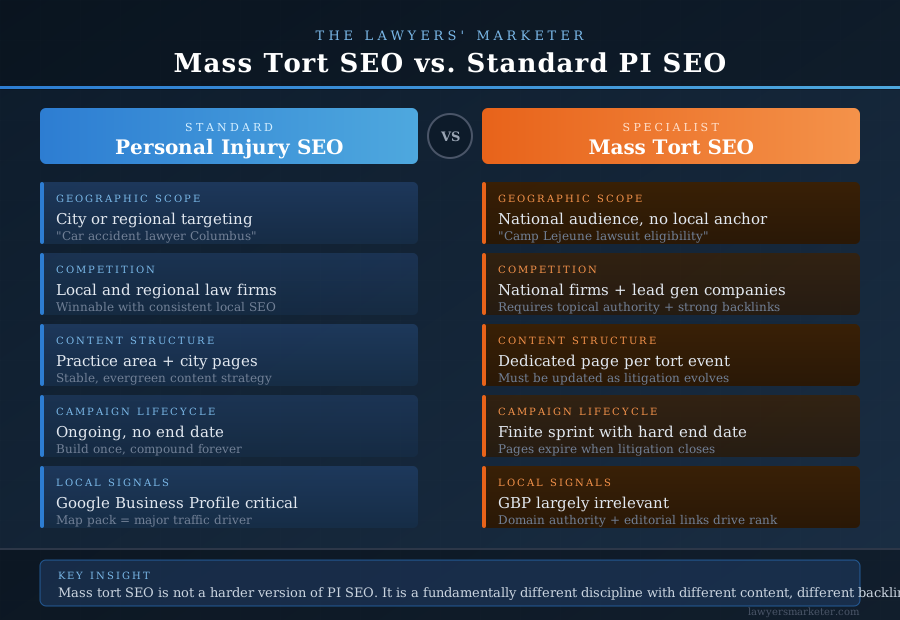
Mass tort SEO is geographically unanchored. Nobody searches “Camp Lejeune attorney near me.” They search “Camp Lejeune lawsuit eligibility” or “do I qualify for the Camp Lejeune settlement” or “Roundup lawsuit filing deadline.” These searchers can be anywhere in the country. They are in an information-gathering phase, trying to determine whether they have a viable claim before they ever call a lawyer.
This distinction changes everything about how you build a campaign focused on SEO for mass tort lawyers.
The second major difference is the lifecycle. A personal injury practice needs to generate leads continuously, year in and year out, from a stable set of recurring practice areas. A mass tort campaign is a sprint with a hard end date. When a litigation event settles or claims stop being viable, the traffic drops and the landing pages become worthless almost overnight. Firms that do not plan for this build pages that become digital dead weight.
The third difference is the competitive landscape. You are not competing with the other three PI firms in your city. You are competing with Morgan and Morgan, Levin Papantonio, Aylstock Witkin, and dozens of other national firms that have built entire infrastructure around mass tort intake. You are also competing with lead generation companies, which are often not law firms at all, just businesses capturing claimant information to sell to attorneys. The organic SERPs for any active mass tort keyword are brutal.
The Aggregator Question: The Most Important Decision You Will Make
Before you invest a dollar in SEO for mass tort cases, you need to settle one question: are you going to build your own direct intake, or are you going to buy leads from aggregators?
There is no wrong answer, but there is definitely a wrong way to do both simultaneously without a plan.
How Mass Tort Aggregators Work
Mass tort lead aggregators are companies that invest heavily in paid and organic search to capture claimant contact information, then sell those leads to law firms. The biggest names in this space include companies like Legal Intake Professionals, WeConserve, and a range of litigation-specific lead gen operations. Some aggregators sell exclusive leads. Others sell the same lead to multiple firms simultaneously.
Lead prices vary dramatically by tort and lead quality. A validated Camp Lejeune lead with confirmed exposure dates and medical documentation might cost $800 to $1,500 or more. A raw, unverified Roundup lead might cost $50 to $200. The difference in quality is enormous and is often not clear until your intake team is already working the lead.
Aggregators are fast to use and require no SEO investment. They are also expensive at scale, create dependency on a third-party pipeline you do not control, and often produce leads of inconsistent quality because the aggregator’s incentive is to maximize volume, not to send you only the strongest claimants.
For smaller or mid-size firms entering mass tort for the first time, starting with aggregator leads while building organic intake in parallel is often the right approach. You are essentially buying time while your SEO infrastructure matures.
Building Direct Intake Through SEO For Mass Tort Lawyers
Direct intake through organic search is slower, harder, and more expensive to build than buying leads. It is also dramatically more valuable once it is working. A claimant who finds your firm through an organic search, reads your content, and calls you directly is far easier to convert and retains at a much higher rate than a shared lead from an aggregator who has already spoken to three other attorneys.
The SEO investment timeline for mass tort is similar to standard law firm SEO: meaningful ranking movement in three to six months, real traffic and leads in six to twelve months, significant competitive positions in twelve to eighteen months or longer for high-competition events. This means you need to start building before the tort is at peak commercial activity, or you will miss the window.
Landing Page Architecture for Mass Tort SEO
This is where most law firms get mass tort SEO wrong. They build one “mass torts” page that lists five or six active litigations with a paragraph about each one, then wonder why it does not rank.
Every active tort event your firm handles needs its own dedicated landing page. And not a thin page. A comprehensive, authoritative resource that a claimant in the information-gathering phase will actually find useful.
Here is what each tort landing page needs to contain.
The Anatomy of a Mass Tort Landing Page
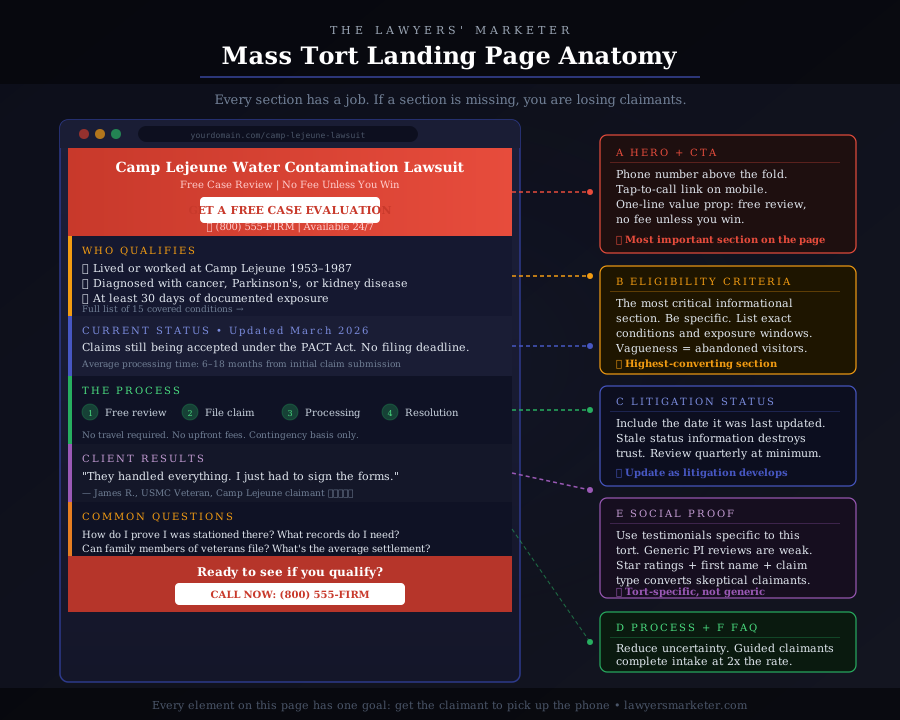
Eligibility criteria, stated clearly. This is the most important section on the page. Claimants searching for information about a specific tort are primarily trying to answer one question: do I qualify? Give them a specific answer. “You may qualify for a Camp Lejeune lawsuit if you lived or worked at Camp Lejeune or MCAS New River between August 1953 and December 1987 for at least 30 days, and you have been diagnosed with one of the following conditions.” List the conditions. Be specific. Do not be vague because you are afraid of scaring people off. The people who do not qualify are not your clients anyway.
The current state of the litigation. Claimants do research. They know whether a litigation has been settled, is active, or is in early stages. A page that describes a litigation as “ongoing” when it settled two years ago destroys your credibility immediately. This section needs to be maintained and updated. It is worth dating the page’s last review so readers know the information is current.
What the process looks like. Walk the claimant through what happens after they call. How long does the claim review take? What documentation do they need to provide? Will they need to travel? What is the contingency fee structure? Claimants who understand the process are far more likely to complete intake. The ones who feel like they are walking into the unknown often never call.
Social proof specific to this tort. A testimonial from a general PI client is not useful on a Camp Lejeune page. If you have settled claims in this litigation or have experience with this specific tort, say so explicitly. If you do not, emphasize your experience with the firm or firms you are co-counseling with.
A frictionless call to action. Phone number at the top, phone number in a sticky bar on mobile, and a short form asking only for name, phone number, and a brief description. The longer your intake form, the higher your abandonment rate. You can gather the detailed documentation later. Get the contact first.
Tort-Specific Pages Worth Building Right Now
The litigations that continue to generate significant search volume and intake as of 2025 and 2026 include:
Camp Lejeune Water Contamination. High-volume, still active with ongoing claims processing under the PACT Act. Eligibility criteria are well-defined. Claimant searches tend to be highly specific because the media coverage has been substantial.
Roundup (Glyphosate) Lawsuits. Still generating intake despite Bayer’s settlement activity. Claimants with Non-Hodgkin’s Lymphoma diagnoses who used Roundup are still filing claims. Search volume remains meaningful.
Talc / Baby Powder (Ovarian Cancer). Johnson and Johnson’s bankruptcy filings have complicated this litigation, but claimant interest remains high and the legal situation is complex enough that content explaining the current status has real value.
AFFF Firefighting Foam. Active litigation with a large eligible claimant population, particularly among military personnel and firefighters. Search volume is growing as awareness increases.
NEC Baby Formula. Earlier stage but growing. Premature infants who developed Necrotizing Enterocolitis after being fed Similac or Enfamil at hospitals represent a significant litigation.
Hair Relaxer / Uterine Cancer. Active litigation. Demographic targeting is important here given the claimant population.
Each of these deserves its own page, its own keyword strategy, and its own link-building effort.
Keyword Strategy for Mass Tort Law Firm SEO
Mass tort keyword research is different from standard law firm keyword research in a few important ways. The volume is more concentrated around specific event names, the intent is heavily informational before it shifts to commercial, and the lifetime of any given keyword cluster is finite.
Mapping the Intent Journey
Claimants searching for mass tort information move through a predictable set of stages, and each stage has different keyword patterns.
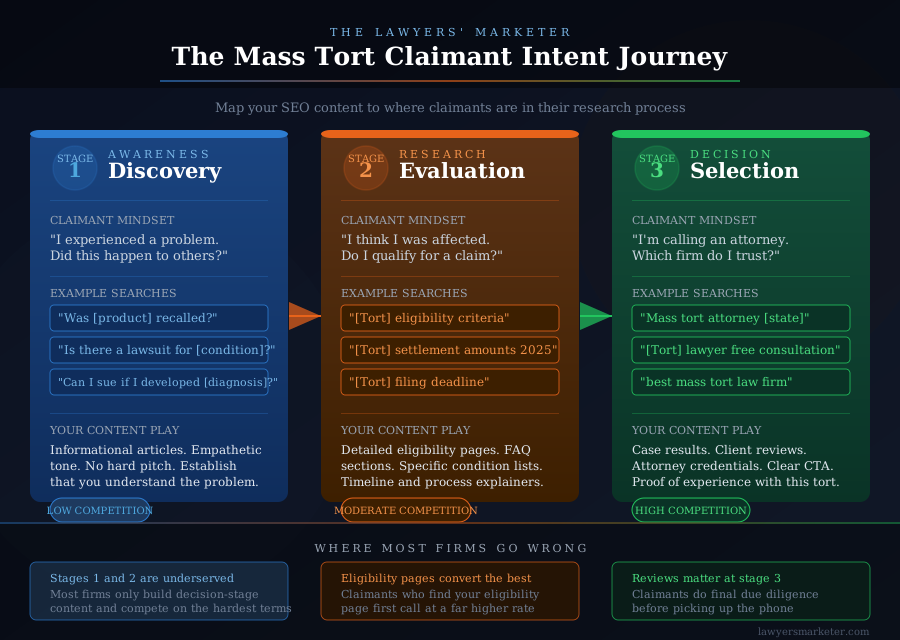
Awareness stage:
“Was [product] recalled?” “Is there a lawsuit for [condition]?” “Can I sue if I developed [diagnosis] from [product]?” These searchers do not know if they have a claim. They are trying to figure out if the problem they experienced is something others have experienced too. Landing content that addresses these queries needs to be informational and empathetic, not a direct pitch for your services.
Research stage:
“Do I qualify for [tort] lawsuit?” “[Tort] eligibility criteria.” “[Tort] settlement amounts.” “[Tort] filing deadline.” These searchers know about the litigation and are actively evaluating whether it applies to them. This is where your detailed landing page content does its best work.
Decision stage:
“Mass tort attorney [city],” “[Tort] lawyer free consultation,” “best mass tort law firm.” These searchers have decided to call an attorney. They are doing final due diligence before picking up the phone. This is where your credibility signals, reviews, and case results matter most.
Most mass tort SEO content focuses on the decision stage, where competition is highest. The real opportunity is in the awareness and research stages, where content is thinner and you can build authority that eventually converts into leads.
National vs. Local Keyword Targeting
Here is where the strategy gets nuanced. Mass tort cases are national in scope, but most searchers still include a geographic modifier because they feel more comfortable hiring an attorney they perceive as local or accessible.
“Camp Lejeune lawyer North Carolina” gets significantly different results than “Camp Lejeune lawyer.” The national searcher is typically captured by the largest national players. The geographic searcher can often be captured by a regional firm with a well-optimized state-specific page.
For firms without national brand recognition, a state-level geographic targeting strategy is often more productive than pure national competition. Build state-specific pages that acknowledge the national scope of the litigation while speaking to the claimant’s likely geographic identity. Someone in Mississippi searching “Camp Lejeune attorney Mississippi” is looking for someone they feel comfortable trusting, and a well-built state page signals that familiarity even if your firm handles cases nationally.
Building Topical Authority in Mass Tort Law
The mass tort space is dominated by national firms and lead gen companies with enormous domain authority. You are not going to outrank them on head terms with a few well-written pages. What you can do is build topical authority around specific litigations by producing comprehensive content that covers the topic in genuine depth.
Topical authority means Google recognizes your domain as an expert source on a specific subject. It is built by covering a topic comprehensively across multiple interlinked pages, not by optimizing one page perfectly.
For mass tort SEO, a topical authority cluster around a specific litigation might include:
- The main landing page (eligibility, process, call to action)
- A long-form FAQ page covering the most common claimant questions
- A page dedicated to specific diagnosed conditions covered by the tort
- A page explaining the legal process timeline and what claimants can expect
- A blog post covering recent litigation news and settlement updates
- A page addressing specific defendant products (brand names matter here)
These pages should link to each other naturally. Google follows the internal link structure to understand the relationship between pages and the depth of your coverage on a topic.
This is similar to the content architecture we describe in our SEO services page and what underpins effective personal injury lawyer marketing. The mass tort version is just more litigation-specific and more content-intensive.
Backlinks for Mass Tort Attorneys
Backlinks matter everywhere in legal SEO. In mass tort, they matter more than in almost any other legal niche because the national competition is so high-authority.
The challenge is that the easiest sources of law firm backlinks, such as local business directories, local chambers of commerce, and local news sites, are geographically anchored in a way that does not map perfectly to a national mass tort campaign.
You need a different backlink strategy.
Sources That Move the Needle in SEO for Mass Tort Lawyers
Legal publications and national directories.
Martindale-Avvo, Justia, FindLaw, and similar directories all pass meaningful authority. More importantly, they are relevant domain types that Google associates with legitimate legal information. These are table stakes, not differentiators, but they need to be in place before anything else.
Health and consumer safety publications.
Tort litigations are inherently consumer safety stories. Sites that cover medical issues, product recalls, and consumer advocacy are natural sources of editorial links for mass tort content. A piece on the Camp Lejeune water contamination timeline that gets picked up by a health-focused publication is more valuable than ten directory links.
News outlets covering the litigation.
This requires outreach and often contribution. Writing a guest piece or being quoted as an expert source in a piece about an active litigation builds the exact kind of authority that differentiates your firm’s content from generic competitor pages. National legal news outlets, as well as regional investigative journalism sites, are worth building relationships with.
Other law firm cross-referral pages.
Firms that do not handle mass tort cases often refer them out. If you can develop co-counsel relationships and get placement on partner or referral pages of established personal injury firms in major markets, those links carry authority and can also generate direct case referrals.
Veterans organizations and military community sites.
For Camp Lejeune and AFFF specifically, sites serving the military community are ideal backlink targets because they reach the exact audience you need and are highly topically relevant.
Our backlinks service page goes into the general framework for building law firm backlink profiles. The mass tort version of that strategy requires more editorial outreach and less reliance on directory submissions.
The Technical Mass Tort Lawyer SEO Foundation You Cannot Skip
Mass tort landing pages serve a national audience that skews heavily toward mobile. Many claimants are older individuals who use smartphones as their primary device, and their technical comfort level may be lower than a typical digital consumer.
Your technical fundamentals need to be airtight.
Page speed is a conversion issue as much as an SEO issue.
A landing page that takes four seconds to load is costing you calls. Google’s Core Web Vitals are a ranking factor, and they also directly correlate with how long a potential claimant will wait before hitting the back button. Aim for Largest Contentful Paint under 2.5 seconds. This usually requires optimized images, minimal third-party scripts, and a hosting environment that can handle traffic spikes when a litigation event hits the news.
Mobile-first design is not optional.
The call to action on your tort landing page needs to be immediately visible on a four-inch screen without scrolling. Your phone number needs to be a tap-to-call link. Your intake form needs to work without zooming or pinching. This sounds obvious. The number of mass tort landing pages that fail these tests would surprise you.
Schema markup helps with rich results.
FAQ schema on your tort landing pages can generate featured snippet opportunities for the research-phase queries. Legal services schema and organization markup help establish entity authority. These are not silver bullets, but they are low-effort implementations that provide incremental benefit.
Site architecture and crawlability.
If you are building multiple tort-specific pages, they need to be organized logically and crawlable. A flat URL structure like yourdomain.com/camp-lejeune-lawsuit/ is better than nested paths for these pages. Your XML sitemap needs to include all active tort pages. Redirects from older or expired pages to relevant active content preserve whatever link equity those pages accumulated.
Paid Search and Mass Tort: A Brief Note
This guide focuses on SEO, but paid search in mass tort deserves mention because the two channels interact directly.
Google Ads for mass tort keywords is extraordinarily expensive. Clicks for terms like “Camp Lejeune lawsuit attorney” or “Roundup lawyer” can exceed $200 to $400 in competitive bidding environments. Without extremely tight targeting, a negative keyword list built from months of data, and dedicated landing pages for each ad group, the cost-per-lead numbers become difficult to justify outside of the highest-value litigations.
Mass tort PPC is largely a tool for large national firms or specialized mass tort marketing agencies. If you are building organic intake through SEO, paid search can be used tactically to capture demand during the first six to twelve months before your organic rankings develop, but you need to budget carefully and track every lead through to intake and signature.
For more on law firm PPC fundamentals, our PPC page lays out the core framework.
Intake Infrastructure: Where Most Mass Tort Campaigns Break Down
You can build the best mass tort SEO campaign in the country and still lose money if your intake infrastructure is not built to handle the traffic it generates.
Mass tort intake is operationally different from standard PI intake in several ways.
The claimant is often older, less tech-savvy, and highly uncertain.
They are not sure if they have a case. They may not have their medical records organized. They may not know exactly when they were exposed to the product at issue. Your intake staff needs to be trained to guide, not interrogate, in the early stages of a call. A claimant who feels like they are being screened out aggressively will hang up and call the next firm on their list.
Speed matters enormously.
Mass tort claimants who reach out through a web form and do not hear back within an hour often do not answer when you call them later. The window of responsiveness is short. You need either a live intake process running during all business hours or an automated acknowledgment that sets a clear expectation for callback timing and actually delivers.
Documentation requirements are different from PI.
Mass tort claims require specific documentation: proof of exposure (purchase records, employment records, discharge papers), medical records confirming the diagnosis covered by the tort, and in many cases, supporting materials that claimants may need weeks to gather. Your intake process should capture enough information to pre-qualify the lead quickly, then guide the claimant through the documentation process over subsequent contacts, not try to gather everything in a single call.
Rejected leads need to be handled carefully.
A claimant who does not qualify for Camp Lejeune may qualify for AFFF if they have a relevant history. A claimant who does not meet the eligibility criteria for Roundup may have a viable product liability claim on different grounds. Intake teams trained to recognize cross-tort opportunities will significantly improve your yield from organic traffic.
Tracking What Actually Matters in Mass Tort SEO
As we emphasized in our personal injury marketing guide, tracking clicks and impressions is not the same as tracking results. Mass tort SEO campaigns need to be measured against signed cases, not traffic.
The measurement chain for mass tort:
- Organic impressions and clicks by page and by tort keyword cluster (tells you which content is getting visibility)
- Calls and form submissions by source (call tracking, tied to the specific page and keyword that generated the contact, using CallRail or a similar tool)
- Qualified leads as a percentage of total intake contacts (tells you whether your content is attracting the right audience or drawing unqualified inquiries)
- Signed cases per tort per month (the only metric that actually matters financially)
- Cost per signed case when lead cost is factored in (critical for comparing your SEO-sourced intake against aggregator leads)
Without this full chain, you cannot make good decisions about where to invest additional budget, which tort pages need to be refined, or whether your SEO campaign is outperforming or underperforming your aggregator spend.
Competing Against National Firms: The Positioning Play
Here is the honest reality of mass tort SEO. If you are a regional firm without national brand recognition, you are not going to outrank Morgan and Morgan or Levin Papantonio on pure domain authority for the highest-competition mass tort keywords. Not in the near term.
What you can do is carve out differentiated positions where the national giants are less competitive.
Geographic specificity.
A Texas-focused mass tort firm can compete more effectively for “Camp Lejeune lawyer Texas” or “Roundup lawsuit attorney Dallas” than for the national head terms. The national players often rely on broad national pages rather than building deep state-specific content because managing that at scale is operationally complex. Regional specificity is an advantage, not a concession.
Emerging or less-covered litigations.
The competition for AFFF or hair relaxer keywords is meaningfully lower than for Camp Lejeune or Roundup because those litigations are at earlier stages. Building authoritative content on emerging tort events before the national players have fully invested gives you a first-mover advantage that compounds over time.
Content depth on specific conditions.
National firms build broad intake pages. A firm that publishes genuinely useful long-form content explaining the relationship between glyphosate exposure and specific Non-Hodgkin’s Lymphoma subtypes, or the specific Navy ships that had contaminated water during the Camp Lejeune period, is providing value that most competitor pages do not. That content earns links, earns rankings, and converts claimants who are deep in the research process.
This is the same principle that differentiates effective criminal defense marketing from generic approaches: depth and specificity beat breadth every time in competitive legal niches.
What a Mass Tort SEO Campaign Actually Costs
There is wide variation in mass tort SEO pricing because it depends heavily on which litigations you are targeting and how competitive the field currently is.
For a regional firm building organic intake for two to three active tort events simultaneously, reasonable budget ranges look like this:
Content production:
4 to 8 pieces per month across tort landing pages, supporting FAQ content, and topical blog updates. At professional legal content rates, expect $3,000 to $7,000 per month for this volume, depending on depth and whether you are also updating existing pages.
Link building:
A dedicated mass tort link building program targeting health publications, legal news outlets, and relevant national directories runs $2,000 to $5,000 per month for meaningful volume. This is not optional if you want to compete nationally or even regionally for contested keywords.
Technical maintenance and SEO management:
Strategy, reporting, technical fixes, and campaign management from an experienced law firm SEO team runs $1,500 to $3,500 per month at minimum.
Total range:
$6,500 to $15,500 per month for a serious campaign. This is not a corner-cutting category. The economics of mass tort are such that one qualified signed case can justify months of investment. But those cases only come if the campaign is built and executed correctly.
Putting It Together: The Mass Tort SEO Roadmap
If you are starting from scratch, here is the sequencing that makes sense.
Months 1 to 2:
Technical audit, site architecture planning, and keyword research. Identify the specific tort events you are targeting, map the keyword intent journey for each, and plan the page structure. Build the foundation before you build the content.
Months 2 to 4:
Launch dedicated tort landing pages with full content treatment (eligibility, process, documentation, FAQs, social proof, and CTA). Submit to major legal directories. Begin link outreach to high-authority targets. Launch call tracking and set up intake reporting.
Months 4 to 8:
Expand topical content clusters around each tort. Publish supporting content that addresses research-phase queries. Continue link building. Refine intake process based on lead quality data. At this stage, you should be seeing organic impressions growing and early ranking movement.
Months 8 to 18:
Rankings for target keywords start generating consistent traffic. Measure signed case rates by tort and adjust content strategy based on conversion data. Begin building content around emerging tort events before peak competition arrives. At the 12-month mark, evaluate whether SEO-sourced intake is outperforming aggregator leads on cost per signed case.
Parting Thoughts on Mass Tort Attorney Marketing
Mass tort SEO rewards firms that commit to it seriously and punishes firms that treat it as an afterthought. The lead gen companies and national giants who dominate this space built their positions over years of sustained investment. You will not close that gap in 90 days.
What you can do is identify the specific litigation events where your firm has a genuine competitive angle, build the deepest and most useful content on the web for your target claimant population, and invest in the intake infrastructure to convert the traffic you generate.
The firms that do this well generate caseloads that are simply not accessible through any other channel at comparable economics. The ones that buy aggregator leads indefinitely without building organic infrastructure stay dependent on a pipeline they do not control, at prices that keep rising as competition intensifies.
Start building now. The litigations that are in early stages today will be peak competition in eighteen months. That is either eighteen months of advantage or eighteen months of delay, depending on what you do with them.
The Lawyers’ Marketer works with SEO for mass tort lawyers and personal injury firms, in addition to link building, and intake strategy. If you want to understand what a realistic mass tort SEO program would cost for your specific firm and which litigations represent the best opportunity right now, reach out here.