

TL;DR
- SEO builds long-term visibility that compounds over time. Google Ads produces leads faster but stops the moment you stop paying.
- Most law firms should run both, but the right balance depends on your practice area, budget, and how quickly you need cases.
- Google Ads makes more sense in the short term if you are new, entering a new market, or testing a new practice area.
- SEO makes more sense as a long-term investment once you are established and want to reduce your cost per lead over time.
- Criminal defense and DUI firms often see the best ROI from Google Ads due to urgency-driven search behavior. PI and family law tend to see strong organic returns with sustained SEO investment.
- The firms consistently winning in competitive markets are doing both, not choosing one or the other.
The Question Most Firms Are Asking Wrong
When a law firm owner asks “should I do SEO or Google Ads,” they are usually asking the wrong question. The real question is: what does my marketing need to do for me right now, and what can I afford to be patient about?
SEO and paid search are not competitors. They are different tools with different timelines, cost structures, and risk profiles. Understanding those differences is what lets you build a channel mix that actually works instead of just throwing money at whichever one your last agency happened to sell.
This post is going to break both down honestly, including the parts most agencies skip over because they make the sale harder.
What Google Ads Actually Does for Law Firms
Google Ads puts your firm at the top of search results immediately. You set a budget, write an ad, and when someone searches “personal injury attorney Tampa” or “DUI lawyer near me,” your ad shows up. You pay when someone clicks. Simple in concept, complicated in execution.
The thing Google Ads does better than anything else is generate leads right now. There is no waiting period, no authority building, no content to write. You are essentially renting visibility while your SEO gets built out, or while you figure out whether a new market or practice area is worth going after.
For law firms, that immediate visibility has real value. A criminal defense attorney who just moved to a new city cannot wait 18 months for SEO to kick in. A personal injury firm launching a new mass tort campaign needs volume fast. Google Ads solves for that.
But it comes with a real cost. Legal keywords are among the most expensive in any industry. “Car accident lawyer” can run $50 to $200 per click depending on your market. “Mesothelioma attorney” keywords have historically hit $300 or more. If your landing page is weak, your conversion rate will be low, and your cost per acquired client will be unsustainable.
The other thing to understand is what happens when you stop. The day you pause a Google Ads campaign, the leads stop. There is no residual value. You are renting traffic, and the landlord does not care about your long-term interests.
For a deeper look at how law firm Google Ads campaigns should actually be structured, our guide to PPC for law firms walks through what to budget, what to track, and how to keep your cost per case under control.
What SEO Actually Does for Law Firms
SEO is the process of building organic visibility in search results so people find you without you paying for every click. It covers your website’s technical health, the content you publish, the authority of your backlinks, and how well your Google Business Profile is optimized for local search.
The difference between SEO and Google Ads is mostly about time and compounding.
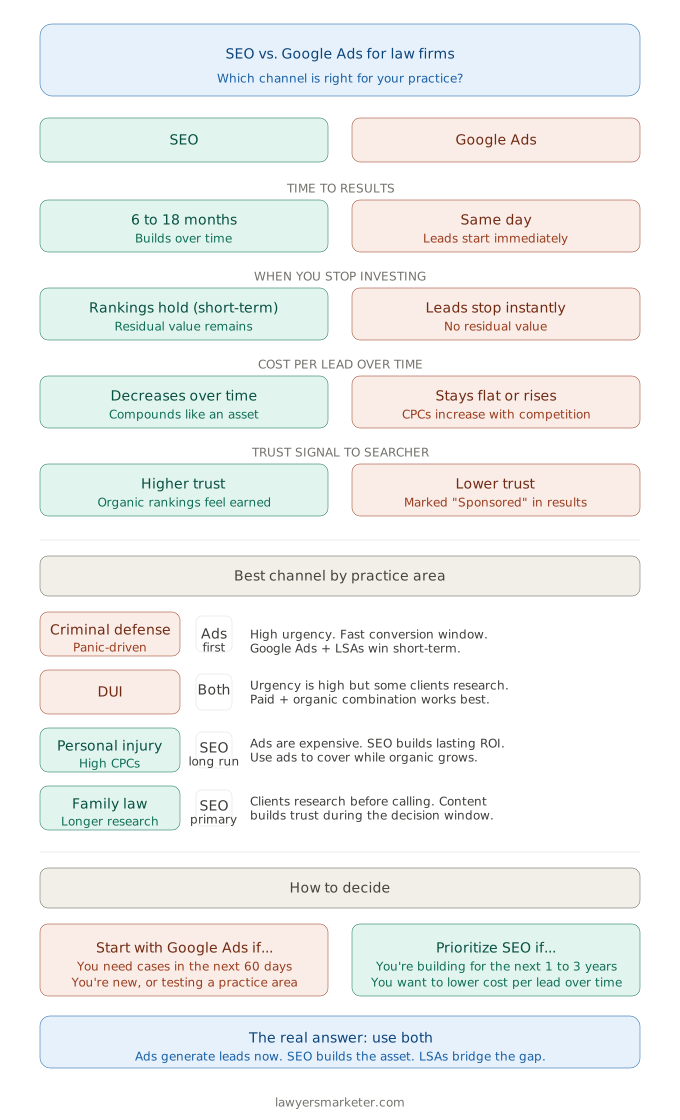
A well-executed SEO strategy takes 6 to 12 months to show meaningful results in most legal markets, sometimes longer in competitive cities. But once you are ranking, you are not paying per click. A page that ranks on the first page for “divorce attorney Chicago” can drive leads every month without ongoing spend. That economics improve dramatically over time while your Google Ads cost per click stays the same or goes up.
The other thing SEO builds that paid search does not is trust. Studies consistently show that organic results get higher trust signals from searchers than ads. That gap matters more in legal than almost any other industry because people hiring an attorney are making a high-stakes, high-emotion decision. Being discoverable organically signals something real to a potential client that a paid placement cannot fully replicate.
The trade-off is patience. SEO requires consistent content production, link building, and technical upkeep. It is not a set-it-and-forget-it channel. Firms that publish a few blog posts and disappear rarely see results. The ones that win treat it like an asset they are building over years.
If you want to understand what an effective law firm SEO strategy looks like at each budget level, check out our breakdown of affordable SEO for law firms.
How the Math Works: Comparing Cost Per Lead
The honest version of this comparison requires looking at cost per lead over time, not just monthly spend.
With Google Ads, your cost per lead is fairly predictable once your campaign is dialed in. If clicks cost $75 on average and your landing page converts at 5%, you are paying $1,500 per lead. If 1 in 4 leads signs, your cost per case is $6,000. That number does not get better unless you work to improve your conversion rate or find cheaper keywords.
With SEO, the early months look terrible on a cost-per-lead basis because you are putting money in and getting little back. But by month 12 to 18, if the strategy is working, you have pages ranking that produce leads at a fraction of the paid search cost. A firm that invested $2,000 per month in SEO for 18 months and is now generating 20 leads per month organically is paying $100 per lead. The paid search equivalent of that volume might cost $30,000 a month.
This is why the comparison between SEO and Google Ads is always a function of time horizon. If you are looking at the next 90 days, Google Ads wins. If you are looking at the next 3 to 5 years, SEO wins by a wide margin.
Practice Area Matters More Than Most Firms Realize in SEO vs. Google Ads
Not all practice areas behave the same way in either channel. Here are a few patterns worth knowing.
Criminal defense and DUI.
These searches are panic-driven and often happen late at night or immediately after an arrest. The client needs help right now and is not comparison shopping for weeks. Google Ads performs extremely well here because the search-to-call window is tight. SEO is still worth building, but criminal defense firms often see faster and more predictable ROI from paid search in the short term. We cover this in more detail in our post on SEO for criminal defense lawyers.
Personal injury.
PI is one of the most expensive Google Ads categories in legal. CPCs are high, competition is fierce, and quality score management matters enormously. A poorly run PI Google Ads campaign will drain budget fast. That said, PI is also one of the highest-revenue practice areas per case, so the unit economics can still work if you know what you are doing. Long-term, PI SEO is one of the highest-ROI investments you can make if you are willing to build a real content strategy. See our full breakdown of personal injury lawyer SEO.
Family law.
Family law clients typically do more research before hiring. They are in a stressful situation but not usually in immediate crisis mode the way criminal defense clients are. This makes SEO particularly effective for family law because content that answers questions builds trust over the research period before someone picks up the phone. Google Ads still works, but the conversion cycle is longer. Check out our family law marketing guide for more specifics.
DUI.
DUI attorney marketing sits somewhere between criminal defense and PI in terms of paid vs. organic dynamics. The urgency is high, but many DUI defendants are not yet in “I need a lawyer right now” mode immediately after an arrest. Some research first. Both channels work here, and the best DUI firms we have seen use a combination. See our DUI attorney marketing guide for the full playbook.
The Local SEO Variable Most Firms Ignore
One channel that belongs in this conversation is Google Local Services Ads, commonly called LSAs. LSAs are different from standard Google Ads because they charge per lead rather than per click, show up above traditional Google Ads in search results, and display a “Google Screened” badge that meaningfully improves trust.
For most law firm practice areas, LSAs should be part of the conversation before you decide how much to put into standard search ads. The cost per lead is often lower, and the lead quality tends to be higher because of how the ads are positioned and verified.
The full paid search picture for law firms is really: LSAs first, then traditional Google Ads to capture what LSAs miss, then organic SEO compounding in the background. Most firms treating this as a binary SEO vs. Google Ads question are missing that three-part structure.
Our law firm SEO service page and PPC service page both explain how we approach each channel.
When to Prioritize Google Ads vs. SEO
There are specific situations where Google Ads should be your primary focus, at least in the short term.
You are a new firm or just launched a new location. You have no organic presence and no time to wait. Google Ads lets you generate cases immediately while your SEO gets built.
You are testing a new practice area. Before you invest months and money into building SEO for, say, immigration law, Google Ads lets you validate demand and see what converts in your market.
You operate in a market with seasonality or time-sensitive campaigns. Mass torts, current-event litigation, and practice areas tied to seasonal events often need fast volume that organic cannot deliver.
You have strong conversion infrastructure. Good landing pages, reliable call tracking, and a quick intake process make paid search economics work. Without those in place, you will bleed budget regardless of how good your ads are.
When to Prioritize SEO vs. Google Ads
SEO should be your primary investment when your time horizon is longer than 12 months and your budget allows for consistent execution.
You have been practicing in the same market for a while and want to reduce your dependence on paid leads. This is the most common situation we see. Firms that have been running Google Ads for years and are tired of the cost realize that SEO could have been building value the entire time.
You are in a practice area where trust and research drive the decision. Estate planning, business law, employment law, and immigration all fit this profile. Clients are not calling the first ad they see. They are reading, comparing, and evaluating. SEO content that answers their questions during that process puts you in the room before they call.
Your competitors are weak on organic. In many mid-size legal markets, the firms showing up in paid search are not showing up in organic, and vice versa. If the organic landscape in your practice area is weak, it is an easier win than competing in the paid auction.
The Answer Most Law Firms Do Not Want to Hear When It Comes To SEO vs. Google Ads
The honest answer to “SEO vs. Google Ads” is that the best-performing law firms run both, and they have a clear plan for how the two channels work together.
Google Ads generates leads now and provides data on what converts. That data informs your SEO content strategy. Your SEO builds the organic authority that brings down your cost per lead over time. Your Google Business Profile and LSAs capture local intent that neither channel fully addresses on its own.
If you have to choose one because budget is genuinely limited, then the decision comes down to timeline. Need cases in the next 60 days? Google Ads. Building a firm you want to be running profitably in 3 years? SEO.
If you want help figuring out which mix makes sense for your practice area and market, that is exactly what we do. You can learn more about our law firm SEO services and law firm PPC services, or get a free backlink audit through our backlinks page to see where your domain stands right now.
The firms that win in competitive legal markets are not the ones who guessed right once on a channel. They are the ones who built a system where every dollar they spend teaches them something and every month compounds on the last. The Google Ads vs. SEO conversation is important, and both should be included in a comprehensive plan.
The Lawyers’ Marketer covers SEO, paid search, and growth strategy for law firms. We are not a “we do everything for everybody” agency. We focus on legal, and we focus on results.