

TL;DR
- Law firms get leads from organic search, Google Ads, Google Business Profile, referrals, legal directories, social media, content marketing, and lead gen services
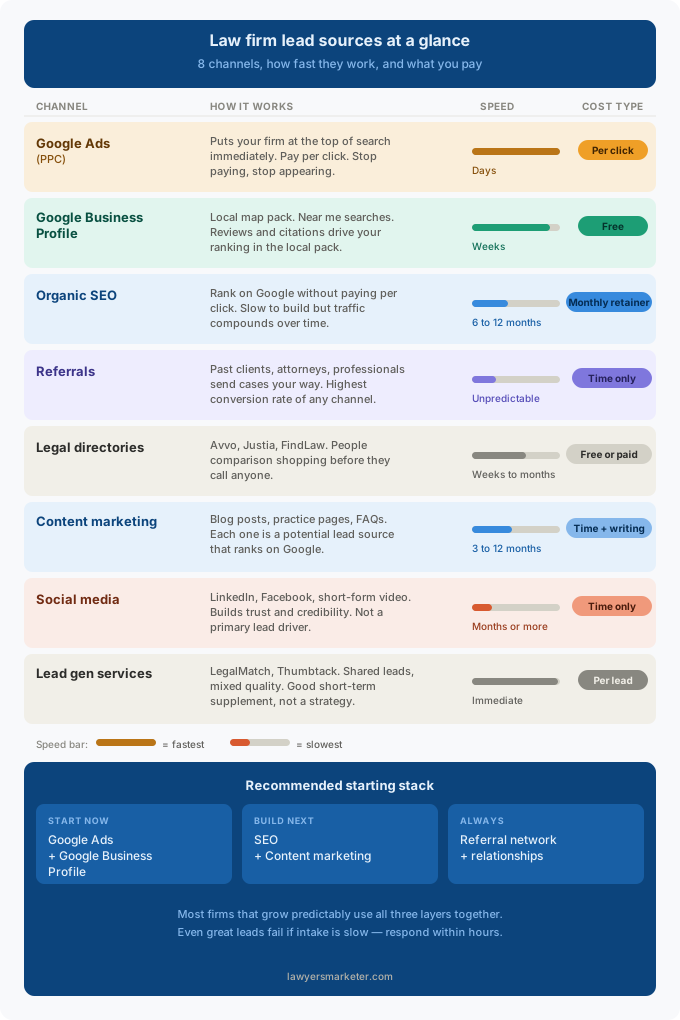
- Each channel works on a different timeline: Google Ads and GBP produce leads fast, SEO takes 6 to 12 months but compounds over time, referrals are the highest-converting source at any stage
- Most firms grow by combining channels, not betting everything on one
- Even great lead generation fails if your intake process is slow, leads go cold within hours
- The right mix depends on your practice area, market, and budget, but there is a starting point that works for almost everyone
Where Do Law Firm Leads Actually Come From?
Most attorneys know they need more leads. Fewer have a clear picture of where leads actually come from and which sources are worth their time and money.
The answer is not one thing. It is several things working together.
Let’s break down every meaningful source of law firm leads, how each one works, and what it takes to get results from each.
1. Organic Search (SEO)
When someone types “personal injury lawyer in [city]” into Google and clicks a result that is not an ad, that is organic search. It is the most valuable long-term source of law firm leads because the traffic is free, the intent is high, and it compounds over time.
The catch is that it takes time. Most law firms start seeing meaningful movement in rankings within 90 to 180 days, and real competitive positioning can take 6 to 12 months. But once you rank, that traffic keeps coming without paying per click.
What drives organic rankings for law firms:
- A technically clean website with fast load speeds and proper structure
- Content that answers the questions your potential clients are actually searching
- Backlinks from credible sources that signal authority to Google
- Local SEO signals that connect your firm to a specific geography
If you are a solo or small firm, you can still compete. We covered this in detail in our post on SEO tips for solo personal injury law firms. The approach for smaller firms is different, but the opportunity is real.
Our law firm SEO service is built specifically around this goal: ranking for the searches that bring in signed cases, not just traffic.
2. Google Pay-Per-Click (PPC) Ads
PPC is how you get to the top of Google right now, before your SEO has had time to build. You pay every time someone clicks your ad. When someone needs an attorney today, Google Ads puts you in front of them at exactly the right moment.
The tradeoff is obvious: stop paying, stop appearing. And legal keywords are not cheap. Personal injury terms in a major metro can run $50 to $150 per click. That sounds alarming until you think about what one signed case is worth to your firm.
The goal is not a low cost per click. The goal is a manageable cost per signed case. A $2,000 monthly budget that consistently signs one or two cases is working. A $5,000 budget that generates clicks but no consultations is not.
Common reasons law firm PPC campaigns underperform:
- The landing page does not match what the ad promised
- The ad copy is generic and does not differentiate the firm
- There is no proper call tracking to know which clicks become clients
- The campaign is targeting too broadly or using the wrong match types
We go deep on this in our law firm PPC guide, including what to look for in a PPC agency and what you should actually be paying.
3. Google Business Profile (Local Pack)
When someone searches “divorce attorney near me” or “DUI lawyer [city]” on their phone, the first thing they usually see is a map with three business listings. That is the local pack, and it runs on Google Business Profile (formerly Google My Business).
For a lot of local searches, the local pack gets more clicks than either the ads or the organic results. It is one of the highest-ROI lead sources available to law firms, and a lot of firms are not optimizing it seriously.
What matters for local pack rankings:
- A complete, consistently updated Google Business Profile
- A steady flow of genuine five-star reviews
- Consistent NAP (name, address, phone) information across the web
- Local citations and directory listings
- Proximity to the searcher
Even if your SEO is not fully built out yet, a well-optimized Google Business Profile can start generating leads in the near term.
4. Referrals
Referrals are still the highest-converting lead source for most law firms. When a former client, another attorney, or a trusted contact sends someone your way, that person already trusts you before they pick up the phone.
The problem is that most firms treat referrals as something that just happens, rather than something they can actively cultivate.
A few things that build a strong referral network:
Former clients.
The easiest referral source you have. If you resolved someone’s case well, they will tell people. But you have to stay top of mind. A simple follow-up email a few months after a case closes, a holiday card, a check-in on a big anniversary or life event. None of this is complicated. Most firms just do not do it.
Other attorneys.
Attorneys refer cases all the time, especially across practice areas. A family law attorney will refer divorce cases, but when that client also needs help with a DUI, they are going to send them somewhere. Be the firm they think of. Take other attorneys to lunch. Return calls promptly. Make it easy to refer.
Professional networks.
Accountants, financial planners, real estate agents, and other professionals touch clients who need legal help. Building relationships with these people, showing up at local business events, being active in your chamber of commerce, all of it matters.
Referrals do not scale the same way digital channels do, but they are the bedrock of most successful law firm growth.
5. Legal Directories
Sites like Martindale-Avvo, Justia, FindLaw, and Lawyers.com get a lot of traffic from people actively looking for attorneys. Claiming and optimizing your profiles on these platforms is relatively low-effort and can generate a steady trickle of leads.
The conversion rates on directory leads tend to be lower than referrals or organic search, because the person is usually comparison shopping across multiple profiles. But the volume can add up, especially in practice areas where people spend time researching before calling.
Paid placements on directories like FindLaw and Martindale are a different conversation. They can be expensive, and results vary widely by market and practice area. If you are considering a paid directory placement, make sure you have clear attribution in place so you know whether it is actually generating cases.
6. Social Media
Social media is not the primary driver of signed cases for most law firms, but it plays a supporting role that is easy to underestimate.
The main value is trust-building. When a potential client is deciding between two firms, they often look at both social profiles before calling. A professional, active presence reinforces your credibility. A dead profile from 2019 does the opposite.
LinkedIn is the most useful platform for most attorneys, particularly for B2B practice areas like business litigation, employment law, or real estate. Facebook still works for consumer-facing practices, especially in family law, criminal defense, and estate planning, particularly for reaching older demographics.
Short-form video on YouTube and Instagram can generate real traction if you commit to it. Attorneys who answer common legal questions in plain English tend to build audiences that convert to leads over time. It takes consistency and patience, but the attorneys doing it well are seeing results.
7. Lead Generation Services
Services like LegalMatch, Thumbtack, and some aggregators will sell you leads directly. You pay per lead or per case type, and they connect you with people actively looking for an attorney.
These services have a mixed reputation, and for good reason. The leads are often shared with multiple firms, so you are competing the moment you get the contact. Quality varies, and the cost per acquisition can creep up quickly.
It is common to get annoyed at the useless law firm leads that come from these services. We get it! You’re paying a few hundred bucks for people who won’t pick up the phone when you call them back, or have legal needs that are outside of your scope. That’s part of the game. Just keep your eye on the ones who DO convert and run the math with a low conversion rate in mind.
That said, some firms use them effectively as a short-term volume play while their SEO and referral network develop. The key is tracking your close rate closely. If you are paying $100 per lead and converting 10%, your cost per client is $1,000. Whether that makes sense depends entirely on the practice area.
Do not make lead gen services the center of your growth strategy. Make them a supplement, if anything.
8. Content Marketing and Blogging
Every piece of content on your website is a potential lead source. Blog posts, practice area pages, FAQ pages, local pages for the cities you serve. Each one targets a specific search query and gives a potential client a reason to call.
The firms that take content seriously build a long tail of organic traffic that generates leads across dozens of keywords. The firms that ignore it rely entirely on paid traffic or word of mouth.
Content marketing is also what powers the other channels. Your SEO is only as good as your content. Your Google Ads landing pages need strong copy. Your social media needs something to post. Content is the foundation.
We have built entire content strategies for law firms in practice areas like personal injury, family law, criminal defense, DUI defense, and estate planning. The approach looks different for each one, but the principle is the same: answer the questions people are searching and make it easy for them to call you.
Which Lead Sources Should You Prioritize?
If you are starting from scratch or trying to figure out where to invest first, here is a reasonable framework:
Short-term (0 to 6 months): Google Ads and Google Business Profile. These generate leads the fastest. PPC puts you at the top of search immediately. GBP optimization can improve your local pack visibility within weeks.
Medium-term (3 to 12 months): SEO and content. Start building organic rankings now so they are producing by the time your PPC budget feels expensive.
Ongoing: Referrals and reputation. Never stop investing in relationships with past clients and fellow professionals. This is the highest-converting, lowest-cost lead source you have.
Supporting: Social media and directories. Low effort relative to return. Keep your profiles current, claim your directory listings, and let them work in the background.
The Intake Problem Nobody Talks About
You can have the best lead generation in your market and still not grow if your intake process is broken. Leads go cold fast. Someone searching for an attorney is usually in a stressful situation and moving quickly. If you do not return calls within hours, they have already talked to three other firms.
We offer a free law firm intake analysis specifically because we have seen firms spending thousands on marketing with a leaky bucket on the other end. Good leads, slow follow-up, lost cases.
If your lead volume is not translating to signed cases, intake is usually the first place to look.
Parting Thoughts On Generating Law Firm Leads
Law firm leads come from a lot of places. The firms that grow predictably are not relying on one channel and hoping it holds. They have a combination of paid and organic search working together, a strong local presence on Google, an active referral network, and a website that earns trust when someone lands on it.
If you want to talk through where your firm stands and what the highest-leverage move is right now, reach out to us. We work with law firms every day on exactly this kind of problem.