

Overview
- Local SEO for personal injury lawyers is mostly a map pack problem, and the map pack is won with proximity, a clean Google Business Profile, and review velocity rather than with more blog posts.
- A virtual office or a coworking desk will get your listing suspended, and reinstatement can take weeks you cannot afford.
- Multiple offices work only when each one has its own staffed address, its own profile, and its own landing page with real local content.
- “Near me” searches and “best personal injury lawyer” searches want different things, so one page cannot serve both well.
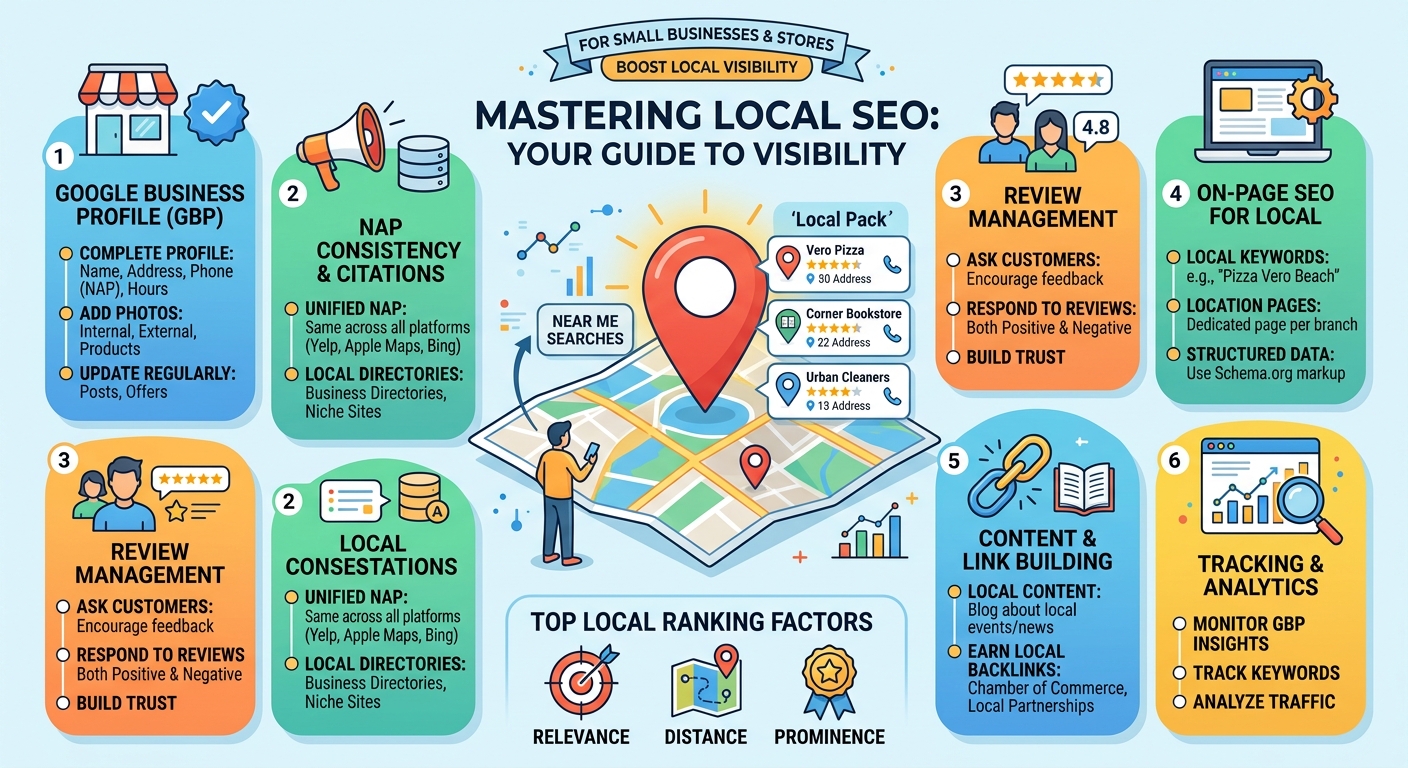
If your firm does not appear in the three business listings above the regular results, you are invisible for the searches that produce the most calls. Somebody who just got rear-ended pulls out a phone, types four words, and taps one of three options. There is no fourth option. That is the whole game in local SEO for personal injury lawyers, and it is a different game from ranking a service page.
We have already covered the broader search side in personal injury lawyer SEO, the solo version in SEO tips for solo personal injury firms, and the full channel mix in internet marketing for personal injury attorneys. None of that gets repeated here. This one stays on the map.
If you do not rank in the map pack at all, do these four things first
In order.
Verify and claim the profile, with the address you actually staff. Not a PO box. Not a registered agent. Not your home unless a client could genuinely come to it and you are willing to show the address publicly.
Set the primary category to Personal Injury Attorney. Not “Lawyer.” Not “Law Firm.” The primary category does more work than almost anything else on the profile, and firms lose rankings for years because someone picked the generic one during setup. Add secondary categories for what you actually do, like Trial Attorney or Workers’ Compensation Attorney, but the primary is the one that matters.
Get ten real reviews in the next sixty days. A profile with two reviews does not compete regardless of how good the rest of it looks.
Fix your citations so the name, address, and phone match everywhere. Old suite numbers and a legacy tracking number on Avvo and Yelp will hold you back.
That is the floor. Our Google Business Profile optimization guide walks through the rest of the fields in detail.
Google Business Profile details that matter for a PI firm
Hours should say open 24 hours only if someone actually answers at 3am, including through an answering service. Otherwise list real hours. Google shows “closed” prominently and it does affect whether people tap.
Services should list the case types you want, one by one: car accidents, truck accidents, motorcycle accidents, slip and fall, wrongful death. Each service accepts a description. Write them.
Photos matter more than lawyers expect. Exterior shots so people can find the building, interior shots of the actual office, and photos of the actual attorneys. Stock photos of a gavel do nothing.
Posts keep the profile active. Case results where your state bar allows them, community involvement, and answers to common questions all work. Weekly is plenty.
The Q&A section is the part almost every firm ignores. You can ask and answer your own questions there. Put the fee structure question in first, because it is the one people are afraid to ask on the phone. For more on the profile itself, see our notes on Google Business Profiles for law firms.
Virtual offices get suspended, and it is not worth the risk
Google’s guidelines require a staffed location where you meet clients during stated hours. A Regus desk you rent for the address does not qualify. Neither does a mailbox service, a shared receptionist suite you visit twice a month, or your cousin’s insurance office across town.
Competitors report these listings, and in personal injury they report them constantly, because one removed pin moves everybody else up. Once you are suspended, reinstatement means submitting documentation and waiting, and you lose the listing entirely in the meantime. A firm that built its lead flow on three fake pins can lose most of its calls in a week.
If you want coverage in a city you do not have an office in, the honest path is a real satellite office with real staff, or ranking that city through organic pages and paid search instead. Local Service Ads are also worth looking at, since they sit above the map pack and have their own verification requirements.
Multiple offices without eating your own rankings
Each real office gets its own profile, its own phone number, and its own page on the site. That page carries the office address, the attorneys who actually work there, directions, parking notes, and content specific to that city. Local courthouses, the roads where crashes happen, the hospitals where clients get treated.
What goes wrong is duplication. Three office pages with identical body copy and the city name swapped compete with each other, and Google picks one or none. Write each one separately or do not build it.
Link each office page from the footer and from the main contact page. Give each one its own schema with the correct address. And avoid the common mistake of pointing all three profiles at the homepage, which wastes the strongest relevance signal you control.
City pages that are not doorway pages
The difference is simple. A doorway page exists to catch a keyword. A real local page exists to help someone in that city.
A doorway page says “our Riverside car accident lawyers fight for maximum compensation.” A real page says which court hears Riverside County civil filings, what the local accident report request process looks like, which intersections generate the most claims, and what the average settlement timeline looks like locally.
That means you cannot build fifty city pages. You can build the six or eight cities where you take real cases, each with real content, and that will outperform fifty thin ones. If a page would not be useful to somebody who already decided to hire you, it will not rank for someone still deciding.
Review velocity beats review count
A firm with 180 reviews and none in the last year loses to a firm with 60 reviews and four last month. Google reads recency, and so do clients.
Build the ask into the case closing process. The moment the settlement check clears is the moment to ask, and it should come from the paralegal or attorney the client actually worked with, not from an automated blast. A text message with a direct link converts far better than an email.
Respond to every review, including the bad ones, without confirming that the person was a client if your state bar rules restrict it. Keep the responses short. Then watch what your competitors are doing, because review growth across a market tells you who is pushing and who has stopped. That is what competitor review tracking is for.
“Near me” and “best personal injury lawyer” are not the same search
“Personal injury lawyer near me” is proximity driven and urgent. The person wants someone close, wants to call now, and is going to tap one of the map results. You win that with your profile, your reviews, and your physical location. Content barely factors in.
“Best personal injury lawyer in [city]” is a comparison search. That person is on their second or third search, reading, and will open several tabs. They want case results, attorney credentials, and proof you have tried cases rather than settled everything. That search is won on the website, not on the map.
Build for both. The map pack feeds the phone. The comparison pages feed the people who call after doing homework, and those clients tend to have better cases. Our list of personal injury keywords breaks the intent categories out further.
Getting the map pack working
Start with the profile, then reviews, then the location pages. Most firms have all three half-done and no idea which one is holding them back.
If you want us to look at where your firm sits in the map pack across your metro and what is actually blocking it, reach out and we’ll run the grid. You can also read more about the way The Lawyers’ Marketer handles local search for injury firms.