
TL;DR
- ChatGPT is the most popular AI tool in the legal industry. It is also the one most often named in sanctions orders against attorneys who filed AI-fabricated case citations.
- The problem is not ChatGPT itself. The problem is using it without guardrails for tasks that demand verifiable accuracy. Mata v. Avianca and a growing list of follow-up cases all share the same fact pattern: a lawyer trusted output that should have been checked.
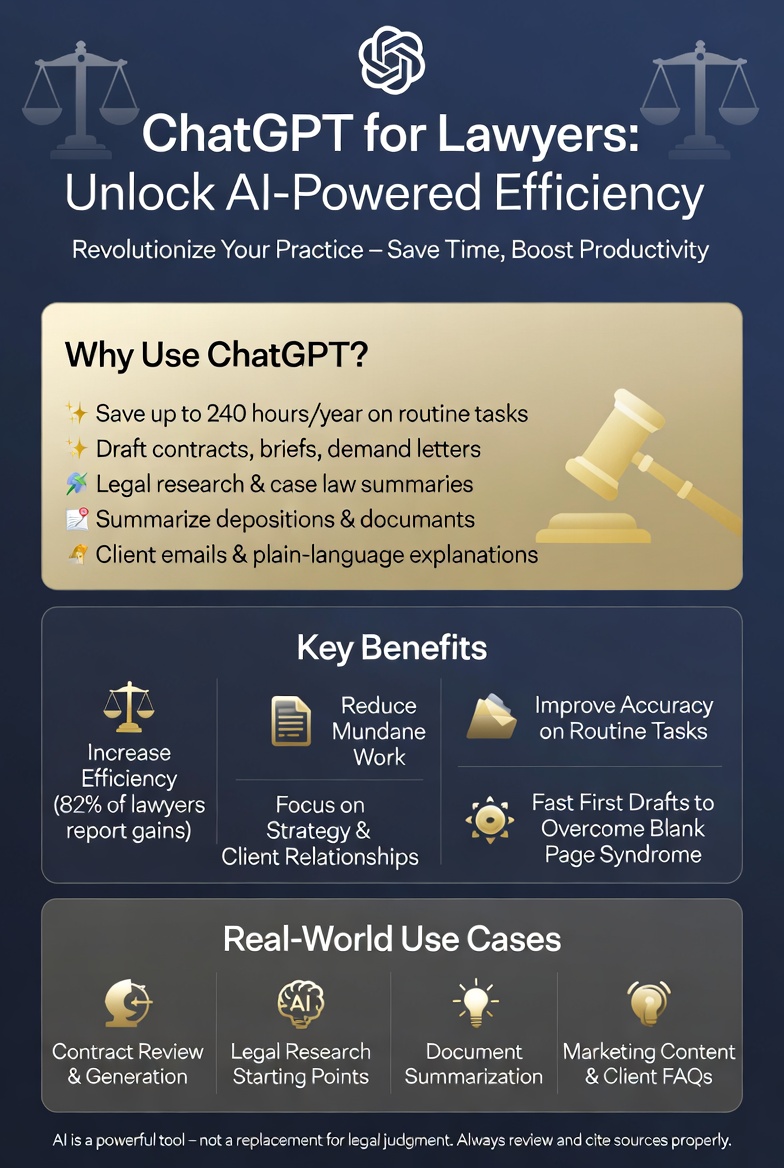
- ChatGPT is genuinely strong at marketing content, intake scripts, internal memos, brainstorming, summarization, voice transcription, and Code Interpreter analysis. Custom GPTs make it easy to standardize firm workflows.
- ChatGPT is risky for anything that ends up in a brief, motion, or settlement demand without independent verification. Citations, statutes, case quotes, and procedural rules all need to be checked against a real legal database.
- Firms that want to run AI across intake, marketing, and operations need more than a $20 per month consumer subscription. They need a policy, a stack, and someone responsible for both. That is where we come in.
The Most Popular Tool in Legal AI Is Also the Most Often Sanctioned
If you ask a random lawyer what AI tool they use, the answer is almost always ChatGPT. It has the largest user base, the broadest brand recognition, and the easiest on-ramp. You sign up, you start typing, and you have something useful within sixty seconds. That ease is exactly why it became the default. It is also why ChatGPT shows up in nearly every cautionary tale legal CLEs love to tell.
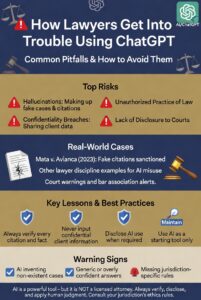
The canonical example is Mata v. Avianca, Inc. The lawyer used ChatGPT to draft a brief. ChatGPT invented six cases that did not exist, complete with fabricated quotes and internal citations. The lawyer filed the brief without checking. The judge issued a five thousand dollar sanction and a public order that put the lawyer’s name in every legal ethics presentation for the next decade.
Mata was not a one-off. Park v. Kim. Johnson v. Dunn. A steady drip of state court matters where briefs cited cases the court could not find. Every state bar has issued some form of guidance. The ABA issued Formal Opinion 512 in July 2024 specifically because of this pattern.
The lawyers in those cases were not sanctioned for using AI. They were sanctioned for not verifying its output. That is the distinction that matters. ChatGPT did exactly what a large language model is designed to do, which is produce fluent, plausible-sounding text. It is not a legal research database. It does not know whether a case is real. When it does not know an answer, it does not stop. It generates something that looks like an answer, which is the worst possible failure mode for legal work.
This is what people mean when they talk about hallucination. It is not a bug that will be patched in the next release. It is a structural property of how these tools work. Newer models hallucinate less. None of them hallucinate zero.
What ChatGPT Is Actually Good At for Law Firms
The hallucination problem is real, and it is not the whole story. ChatGPT does a lot of things well, and there are tasks where it is genuinely the best tool for the job.
Marketing content and first drafts
This is the strongest use case for ChatGPT in a law firm setting. Blog posts, social captions, ad copy, landing page drafts, email newsletters, intake follow-up sequences. Anything where the lawyer is the source of truth and ChatGPT is just speeding up the writing. The output gets edited by a human anyway, so a stray inaccuracy gets caught before publication. The leverage is real. A solo attorney who used to publish one blog post a month can publish four. A marketing coordinator who used to draft three social posts a day can draft fifteen.
If marketing is your entry point for AI, our law firm content marketing guide walks through how to build a content engine without sacrificing voice.
Intake scripts and client communication templates
ChatGPT is excellent at producing standardized scripts for receptionists, intake specialists, and after-hours answering services. Plug in the practice area, the firm’s tone, and the qualifying questions, and it produces a usable draft in seconds. Same for hold messages, voicemail greetings, email templates for common client situations, and FAQ libraries for the website. These are template tasks. ChatGPT was built for template tasks.
Internal memos and meeting summaries
Recorded a team meeting? Paste the transcript in and ask for a summary with action items. ChatGPT is reliable here because the source material is right in front of it. There is no opportunity to hallucinate a fact that was not in the input. Same for synthesizing case notes, summarizing intake calls, or turning rough partner dictation into a clean internal memo.
Custom GPTs for repeatable workflows
This is where ChatGPT pulls ahead of plain chat tools. A Custom GPT is essentially a saved configuration. You build it once with your firm’s voice, your style guide, your standard intake questions, your preferred citation format, and your practice area context. Then anyone in the firm can use it without retyping the setup every time. Smart firms build Custom GPTs for things like converting a CRM note into a follow-up email, drafting demand letter outlines from intake summaries, or generating practice-area-specific blog briefs.
Code Interpreter and data analysis
If you have a spreadsheet of intake leads, a CSV export from your case management system, or a list of marketing spend by channel, ChatGPT’s Code Interpreter can analyze it. It writes and runs Python in the background. You ask plain English questions and it returns charts, tables, and summary statistics. For firms that have data sitting in a Lawmatics or Filevine export and no one with the time to analyze it, this is a meaningful unlock.
Voice mode
The mobile voice feature is genuinely useful for lawyers who want to talk through a case strategy on a commute, dictate a rough outline of a brief, or brainstorm cross-examination angles out loud. Treat the output the same way you would treat a recorded conversation with a smart paralegal. It is a starting point, not a final product.
Where ChatGPT Gets Lawyers Into Trouble
The pattern is consistent. Trouble happens when ChatGPT is asked to produce output that contains specific verifiable claims, and the lawyer treats that output as authoritative.
Anything involving case citations
This is the big one. Do not ask ChatGPT to find supporting case law, or to summarize a specific case unless you have the actual opinion pasted into the conversation. Also, do not ask it to compare authority across jurisdictions. Even the newer models with browsing turned on can produce citations that look plausible and are not real.
If you need legal research, use a legal research tool. Westlaw, Lexis, Casetext, vLex Fastcase. These are built on actual case law databases. ChatGPT is not.
Statutory references and procedural rules
Same problem. ChatGPT may produce a statute reference that does not match the current version of the law, or cite a Federal Rule of Civil Procedure that was amended years ago. Always verify against the actual code or rulebook.
Anything that depends on jurisdiction-specific knowledge
Bar admission rules, advertising compliance rules, deadline calculations under state procedural codes, fee splitting rules, IOLTA requirements. ChatGPT will produce an answer. The answer may be a confident description of how things work in a state you have never practiced in. Verify against the actual state bar source.
Client-specific advice
Never paste confidential client information into a free or even Plus tier of ChatGPT for substantive advice. Even on Team and Enterprise plans where data is not used for training, the bar ethics question of whether you have informed the client about AI use is still live. ABA Formal Opinion 512 walks through this. Most state bars have followed with their own variants. Read the guidance for your jurisdiction.
ChatGPT vs Claude vs Specialized Legal AI
The natural follow-up question is which AI tool a law firm should use, and the honest answer is “more than one.” Different tools are good at different things.
ChatGPT has the strongest consumer ecosystem, the best voice and mobile experience, the most polished Custom GPT system, and the broadest plugin and integration library. It is the right default for marketing, communications, and brainstorming.
Claude has lower hallucination rates on long-document work, a million token context window that can hold an entire case file in a single conversation, and a more careful tone for legal analysis. We wrote a full breakdown of Claude AI for lawyers covering its specific advantages for legal work.
Specialized legal platforms like Harvey, CoCounsel, Lexis+ AI, and Vincent are built on top of vetted legal databases. They are far more expensive than consumer tools. They are also far less likely to invent a case. If your daily work is litigation research and brief drafting, a specialized platform earns its cost. If your daily work is content, intake, and operations, it does not.
Most firms end up running a small stack. ChatGPT for marketing and communications. Claude for long-document review and high-stakes drafting. A specialized legal AI for actual research and citation work. The full picture, including how AI is changing search itself, is covered in our legal AI guide.
A Sensible ChatGPT Setup for a Law Firm
If you are running a small or mid-sized firm and want ChatGPT in the building without ending up in a sanctions order, here is the short version.
Get on a Team or Enterprise plan, not Plus. The Team plan is twenty-five dollars per user per month and gives you a workspace where conversations are not used for training. That alone resolves a meaningful chunk of the confidentiality question.
Write a one-page AI policy. State what ChatGPT can and cannot be used for. Require human verification of any output that contains citations, statutes, deadlines, or jurisdiction-specific procedural claims. Require disclosure to clients when AI is being used for substantive work on their matter. Most firms over-engineer this document. One page is plenty if the page is clear.
Build three Custom GPTs that match your highest-frequency tasks. For most firms that means an intake follow-up writer, a blog draft generator, and a client-friendly explainer of common legal concepts.
Pick one person who owns AI for the firm. Not a committee. Someone whose name is on the policy and who attends the relevant CLEs.
Audit quarterly. Pull a random sample of AI-assisted work product and verify it. The goal is not to play gotcha. It is to catch drift before drift becomes a sanctions order.
Where We Can Help
A law firm can run ChatGPT off the shelf and get real value. Marketing content output goes up. Intake response times get faster. Internal memos write themselves.
A law firm that wants to run AI across the whole operation, not just inside one chat window, needs more than a subscription. It needs a policy, a stack, the right Custom GPTs and Projects, integrations with the case management system, a content workflow that uses AI without losing the firm’s voice, and someone who actually understands legal marketing to set the whole thing up.
That is what we do. Foxtown Marketing’s sister brand Lawyers Marketer works exclusively with law firms, and AI is now woven through every service we offer, from SEO and content to intake and operations consulting.
If you want help moving past the consumer ChatGPT experience and building an AI-integrated firm, get in touch. The firms that figure this out in the next twelve months will pull meaningfully ahead of the ones that do not.
Frequently Asked Questions
Is it safe for lawyers to use ChatGPT?
Yes, for tasks that do not require verifiable accuracy. Marketing content, intake scripts, internal memos, and brainstorming are low risk. Legal research and citation work are high risk. The line is whether the output is going to be filed with a court or shown to a client as authoritative.
Why do lawyers keep getting sanctioned for using ChatGPT?
Almost every sanction case shares the same fact pattern. The lawyer asked ChatGPT for case citations, ChatGPT generated cases that did not exist, and the lawyer filed the brief without checking. Mata v. Avianca is the canonical example. Park v. Kim and Johnson v. Dunn are more recent. The court is not punishing the use of AI. It is punishing the failure to verify.
What plan of ChatGPT should a law firm use?
Team or Enterprise. The twenty dollar Plus plan does not give you a workspace with proper data controls. Team is twenty-five dollars per user per month and confirms that conversations are not used for training. Enterprise adds audit logging, longer context, and admin controls for larger firms.
Can I paste a confidential document into ChatGPT?
On the Plus tier, the safer answer is no. On Team and Enterprise, data is not used for training, but the underlying ethics question of client consent under ABA Formal Opinion 512 still applies. Check your state bar’s guidance. Most state bars have issued opinions specifically on this.
Is ChatGPT better than Claude for legal work?
Different tools, different strengths. ChatGPT has the better consumer ecosystem and Custom GPT system. Claude has lower hallucination rates on long documents and a larger context window. Many firms use both. The full comparison is in our Claude AI for lawyers post.
What about Custom GPTs?
Custom GPTs are saved configurations of ChatGPT with specific instructions, files, and behaviors baked in. They are very useful for law firms because they let you standardize a workflow once and reuse it across the team. Build one for intake follow-up, one for blog drafts, and one for explaining legal concepts to clients in plain English, and you have most of the marketing and intake load covered.
Can ChatGPT do legal research?
Not reliably. It can summarize a case if you paste the opinion in. It cannot be trusted to find cases on its own, even with browsing enabled. Use Westlaw, Lexis, Casetext, or vLex Fastcase for actual legal research.
Does ChatGPT work for SEO and content?
Yes, and this is one of its strongest use cases for law firms. With a clear prompt and a clear brand voice, it can produce blog drafts, practice area page outlines, FAQ sections, and meta descriptions at a pace no in-house writer can match. The output still needs editing for accuracy, voice, and jurisdiction-specific compliance. See our law firm content marketing guide for the full workflow.
What is ABA Formal Opinion 512 and do I need to read it?
Yes, you need to read it. It is the ABA’s first formal ethics opinion specifically on generative AI in legal practice. It walks through how the existing Model Rules of Professional Conduct apply to AI use. The five duties it covers are competence, confidentiality, communication with clients, candor toward the tribunal, and supervision of nonlawyer assistance. Most state bars have issued their own opinions that track Formal Opinion 512 closely.
How do I build a firm-wide AI strategy without overthinking it?
Start with one practice area, one workflow, and one tool. Run it for ninety days. Measure what changed. Then expand. Firms that try to launch a comprehensive AI rollout in month one usually end up with a policy document and no actual adoption. Firms that start small and expand based on what is working end up with real leverage. If you want help building that rollout, contact us.