
TL;DR
- There are at least four distinct types of law firm marketing agencies, and they serve very different needs at very different price points
- Full-service agencies, SEO-only shops, PPC specialists, and AI-powered platforms are not interchangeable
- Most agencies are bad at one of three things: setting realistic expectations, reporting on what actually matters, or scaling when your firm grows
- Pricing ranges from $1,500/month to $15,000+/month depending on the model and scope
- The single most important thing to verify before signing any contract is whether the agency can show you real case attribution, not just traffic and impressions
- Use the 10-point scoring rubric at the bottom of this post to compare any agency before you commit
If you are a managing partner shopping for a law firm marketing agency right now, you already know that the market is noisy. Everyone claims to specialize in legal. Everyone has a case study. And almost nobody publishes pricing.
This post is the guide we wish existed when we started working with law firms. We are going to name names, distinguish between categories, give you real pricing ranges, and hand you a scoring rubric you can use to evaluate any vendor you talk to.
We will also tell you the truth about some popular law firm marketing agency options in the market, including AI-powered platforms that have raised a lot of venture capital and generate a lot of buzz, because that is the kind of honest information most “comparison” posts avoid.
Why Choosing the Wrong Law Firm Marketing Agency Is an Expensive Mistake
Legal marketing is not like marketing a restaurant or an e-commerce brand. The keywords are among the most expensive in all of Google Ads. Personal injury terms in a major metro can run $75 to $200 per click. Family law terms in a competitive city are not far behind. A single month of misdirected ad spend can run $5,000 to $20,000 with almost nothing to show for it.
Beyond the money, there is the opportunity cost. A firm that spends 12 months with the wrong SEO agency has not just lost the fees they paid. They have lost a year of compounding organic growth that a good agency would have built during that same window.
Most managing partners we talk to have already been burned once. They hired someone who sounded credible, got monthly reports full of metrics they didn’t understand, and eventually realized that none of it was producing cases. That experience is common, and it is avoidable.
The problem is usually not that the firm made an uninformed decision. It is that the information available to make that decision was either incomplete or written by the vendors themselves.
The Four Types of Law Firm Marketing Agencies
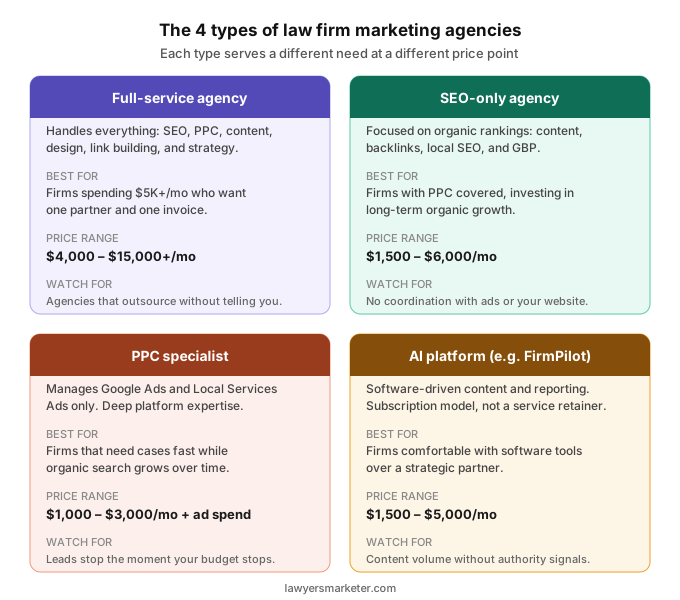
Before you can evaluate an agency, you need to understand which kind of agency you are actually looking at. These four categories behave differently, charge differently, and are appropriate for different situations.
1. Full-Service Law Firm Marketing Agencies
A full-service legal marketing agency handles everything: SEO, Google Ads, website design and maintenance, content creation, link building, and sometimes intake support or CRM consulting. You have a single point of contact and a single monthly invoice.
The best full-service agencies understand the legal industry deeply and can allocate resources across channels based on what is actually working for your firm in real time. If your Google Ads are burning through budget without producing calls, a real full-service partner adjusts the strategy rather than optimizing for their own deliverables.
The downside is that full-service coverage is expensive, and not every agency that claims to be full-service actually is. Many agencies say they handle everything but outsource large parts of the work to contractors, sometimes overseas, with inconsistent quality control.
Who this is right for: Firms spending $5,000 or more per month on marketing, or firms that want to hand off the entire function and not have to manage multiple vendors.
Typical pricing: $4,000 to $15,000+ per month, depending on scope and market.
2. SEO-Only Law Firm Marketing Agencies
These agencies do one thing: help your firm rank in Google’s organic results. That includes technical SEO, content creation, link building, local SEO, and Google Business Profile optimization. They do not run ads, and they are not trying to.
SEO-only shops are often more affordable and more focused. If your firm’s specific pain point is organic visibility and you already have a PPC agency you trust, an SEO specialist can make sense.
The risk is coordination. If your SEO agency is building content that contradicts what your PPC landing pages are doing, or if your website has technical issues that no one owns, you end up with gaps nobody is responsible for.
Our SEO services for law firms are built specifically around the ranking signals that matter in legal search, including local pack visibility, practice area page structure, and the backlink profile requirements that competitive markets actually demand.
Who this is right for: Firms with a solid PPC operation already in place, or firms on a tighter budget that want to invest in long-term organic growth.
Typical pricing: $1,500 to $6,000 per month.
3. PPC-Only Agencies and Google Ads Specialists
Some agencies focus exclusively on paid search. They build and manage your Google Ads campaigns, your Local Services Ads, and sometimes your Bing campaigns, but they do not touch your website or your organic strategy.
The upside of PPC specialists is depth. They are inside the ad platforms every day, and good ones have law firm-specific knowledge of how to structure campaigns, which negative keywords to use, how to bid on mass tort terms, and how to structure ad groups by practice area and geography.
The downside is that PPC without organic is a treadmill. The moment you stop paying, the leads stop coming. Firms that rely exclusively on paid search are also more vulnerable to the regular cost increases that happen when competitors enter their market.
If you want to understand how paid and organic work together, our breakdown of law firm PPC agency selection covers what to look for and what to pay.
Who this is right for: Firms that need cases fast and have the budget to sustain paid acquisition while organic grows, or firms that have a long-term SEO partner but need better PPC management.
Typical pricing: $1,000 to $3,000 per month in management fees, plus your ad spend on top of that.
4. AI-Powered Legal Marketing Platforms
This is the newest category and the one that has attracted the most investment in the past few years. These platforms have raised significant venture capital and built software-driven approaches to law firm marketing that use AI to generate content, automate reporting, and scale production.
These platforms represent a real departure from the traditional agency model. Instead of a dedicated account manager and a custom strategy, you are working within a product. The software drives the content. The reporting is built into a dashboard. And the pricing is usually structured as a monthly software fee rather than a service retainer.
The honest answer on these platforms is that the value proposition depends heavily on what your firm actually needs. If you need volume, automation, and software-style reporting, an AI platform might fit. If you need strategic judgment, custom positioning, and a partner who will tell you something is not working and recommend a pivot, the software model has real limitations.
AI platforms also tend to be better at producing content than they are at building the link profile and local authority signals that competitive markets require. Content at volume is a capability. Domain authority is a relationship and an investment.
There is a broader question here about whether your firm’s marketing should look like every other firm using the same platform. AI-generated content from any platform eventually converges on similar output. That is not a knock on any specific company. It is a structural feature of how these systems work.
If you are evaluating one of them, we have written a more detailed comparison that looks at where AI platforms fit in the law firm marketing stack and where they fall short. That post is worth reading before you sign a contract with any software-first vendor.
Who this is right for: Firms that are comfortable with a software-driven approach, have a clear content gap they need to close quickly, and understand that the platform is a tool rather than a strategic partner.
Typical pricing: $1,500 to $5,000 per month, often tiered by firm size or campaign scope.
What Actually Matters: The Metrics That Separate Good Law Firm Marketing Agencies From Bad Ones
Most agencies will show you traffic reports. The good ones will show you something else.
Here is the difference between what agencies typically report and what actually matters for a law firm.
Traffic Is Not Cases
Website traffic is a vanity metric unless it is converting. An agency that shows you a chart of rising organic sessions but cannot tell you how many of those sessions turned into phone calls, contact form submissions, and signed retainers is either not measuring the right things or hoping you are not asking the right questions.
The metric that matters is cost per signed case or cost per qualified lead, depending on how far the attribution goes. Every other number is a proxy, and proxies can be gamed.
Rankings Without Revenue Context Are Meaningless
Ranking number three for “personal injury attorney [city]” sounds like a win. And it might be. But if you are ranking for terms that nobody is searching, or terms that attract people in the research phase who will never hire an attorney, the ranking does not move the needle.
Ask any agency you are evaluating to show you which keywords they plan to target, what the estimated monthly search volume is for those terms, and how they will track whether the traffic from those keywords is actually converting.
Lead Quality Beats Lead Volume
A firm that signs five high-value cases per month from 40 leads is in a better position than a firm that gets 200 leads and signs five cases. If your agency is optimizing for lead volume without qualifying for case type and case value, you are paying for a metric that does not map to your revenue.
Call tracking is the infrastructure that makes lead quality measurement possible. Without it, you are essentially flying blind. If you want to understand how call tracking works in a law firm context and which tools are worth using, the breakdown in our call tracking for law firms section covers the major options.
Red Flags That Should Stop You From Signing
These are not hypotheticals. These are patterns we have seen repeatedly in the law firm marketing space.
Guaranteed rankings.
No ethical SEO agency guarantees specific rankings because Google’s algorithm is not something any vendor controls. Anyone who promises you page one placement in a specific timeframe for a specific keyword is either lying or planning to game the system in ways that will eventually get your site penalized.
No interest in your intake process.
Marketing generates leads. Your intake team closes them. If an agency is not asking about your intake process, your call answer rates, and your follow-up sequence, they are optimizing for something that stops at the click, not the case.
Opaque reporting.
If you cannot tell from your monthly report which specific activities produced which results, something is wrong. You should be able to see which keywords are driving traffic, which landing pages are converting, and how your Google Ads campaigns are performing at the keyword level.
Long-term contracts without performance milestones.
Twelve-month contracts are standard in this industry, but good agencies will include performance expectations in writing. If an agency wants a 12-month contract but will not commit to any specific deliverables or benchmarks, that tells you something.
Same deliverables for every client.
Legal marketing looks different for a solo criminal defense attorney in a mid-size city than it does for a 15-attorney personal injury firm in a major metro. If an agency cannot explain how their strategy for your firm specifically differs from their standard approach, they are probably running a template.
No specialization in your practice area.
Personal injury, family law, criminal defense, and estate planning are all very different from a marketing perspective. The buyer journey is different. The keywords are different. The competitive dynamics are different. If the agency you are talking to cannot speak fluently about the specific challenges in your practice area, they are going to have a steep learning curve at your expense.
We have written practice-area-specific resources for a reason. The playbooks for personal injury lawyer marketing, family law marketing, divorce attorney SEO, DUI attorney marketing, and criminal defense marketing all look different because they should.
How to Compare Law Firm Marketing Agencies: The 10-Point Rubric
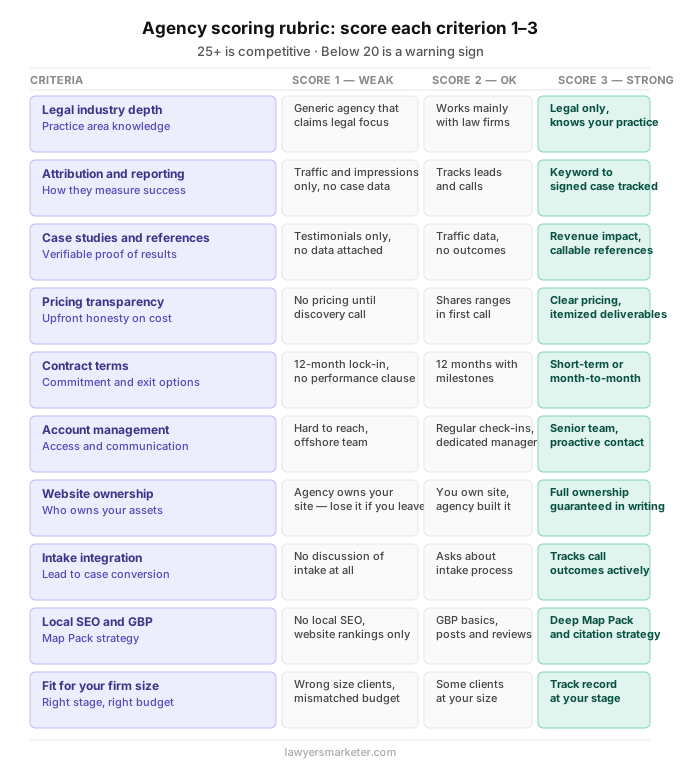
Use this rubric when you are in the evaluation phase. Score each agency on a scale of one to three for each criterion. A score of 25 or above is competitive. Below 20 is a concern.
1. Legal Industry Depth (1-3)
Can they speak specifically about the marketing challenges in your practice area? Do they know what LSAs are and how they interact with Google Ads? Can they explain the difference between a Map Pack ranking and an organic ranking?
- 1: Generic marketing background, claims to work with law firms
- 2: Works primarily with law firms, familiar with legal search
- 3: Specializes exclusively in legal, deep knowledge of your specific practice area
2. Attribution and Reporting (1-3)
How do they measure success, and how transparent is the reporting?
- 1: Traffic and impression reports only
- 2: Tracks leads and calls, some connection to outcomes
- 3: Full funnel tracking from keyword to call to signed case, call recording review included
3. Case Studies and References (1-3)
Can they show you real results from real law firms in comparable markets?
- 1: Testimonials only, no data
- 2: Case studies with traffic or lead data, no case outcome data
- 3: Verifiable results showing revenue impact, willing to provide references you can actually call
4. Pricing Transparency (1-3)
Do they tell you what things cost upfront?
- 1: Will not share pricing until discovery call, has no published pricing
- 2: Provides ranges during initial conversation
- 3: Clear pricing structure with itemized deliverables, no hidden fees
5. Contract Terms (1-3)
What are the commitment terms and exit provisions?
- 1: 12-month contract, no performance clauses, difficult cancellation
- 2: 12-month with performance milestones, some flexibility
- 3: Month-to-month or short-term commitment available, performance benchmarks in writing
6. Communication and Account Management (1-3)
How accessible are they, and who actually manages your account?
- 1: Account manager you cannot reach, work done by offshore team
- 2: Regular check-ins, dedicated account manager
- 3: Strategic partner access, senior team involved in your account, proactive communication
7. Website Ownership and Control (1-3)
Who owns your website and what happens when you leave?
- 1: Agency owns your site, you lose it if you cancel
- 2: You own the site, agency built it on their preferred platform
- 3: You own everything, full access and portability guaranteed in writing
8. Intake Integration (1-3)
Do they understand that marketing ends when the case is signed?
- 1: No discussion of intake process
- 2: Asks about intake, offers basic guidance
- 3: Actively works to improve lead quality and intake conversion, tracks call outcomes
9. Local SEO and GBP Management (1-3)
Do they actively manage your Google Business Profile and local presence?
- 1: No mention of local SEO, focused only on website rankings
- 2: Covers GBP basics, posts and reviews
- 3: Deep local SEO strategy including citation management, competitor GBP analysis, and Map Pack optimization
For context on what a strong local SEO approach looks like, our affordable SEO for law firms guide breaks down the local ranking factors that matter most.
10. Fit for Your Firm Size (1-3)
Are they actually set up to serve a firm at your stage?
- 1: Works primarily with much larger or much smaller firms
- 2: Has some clients at your size, no specific program for your stage
- 3: Clear track record with firms at your size, understands your budget constraints and growth goals
What You Should Expect to Pay: Real Pricing Ranges in 2026
The law firm marketing agency market does not publish pricing the way SaaS companies do, which makes comparison shopping harder than it needs to be. Here is what we see in the market.
Entry-level SEO retainers:
$1,500 to $3,000 per month. At this level you are typically getting one or two blog posts per month, some basic technical work, and local SEO maintenance. This is appropriate for solo practitioners or very small firms in less competitive markets.
Mid-range SEO retainers:
$3,000 to $6,000 per month. This is where serious organic growth starts. Expect aggressive content production, link building as a regular line item, and meaningful technical work.
Full-service retainers:
$5,000 to $15,000+ per month. This is the range for firms that want to hand off the entire marketing function, including paid and organic. At the higher end you are typically working with a senior team with deep legal marketing experience.
PPC management fees:
$1,000 to $3,000 per month in fees, with ad spend on top. The ad spend for a competitive personal injury practice in a major market is typically $5,000 to $20,000 per month or more.
AI platform pricing:
Typically $1,500 to $5,000 per month, depending on firm size and scope. These are usually software subscription structures rather than service retainers.
One-time website builds:
$8,000 to $25,000 for a purpose-built law firm website from a specialist agency. Template-based builds are cheaper but come with limitations in customization and SEO architecture.
How These Law Firm Marketing Agencies Compare
We are going to be direct here because that is the point of this post.
The Lawyers’ Marketer is a law firm marketing agency. We work specifically with law firms, we publish our pricing ranges, and we are biased. You should factor that into how you read this section.
What we offer is hands-on work from people who understand legal marketing. We are not an AI platform selling you a software subscription. We are not a generalist agency that also does law firms. Every client we take on is a law firm, and our services, including SEO, PPC, link building, and strategy, are built around how legal clients actually make hiring decisions.
We believe in transparency about what works and what takes time. If you want an honest conversation about whether your firm is a good fit for what we do, our intake analysis is a good starting point. It is free, it is not a sales pitch, and it gives you something useful regardless of whether you hire us.
If you are looking at other options in this market, the honest answer is that there are good agencies in each of the four categories described above. The right one depends on your firm’s size, your practice area, your competitive market, and how much strategic involvement you want from a marketing partner.
What we would caution against is making a decision based on a platform’s fundraising announcement or the size of their marketing team. The agencies that produce results for law firms are the ones that understand the difference between a click and a case.
The Questions to Ask Before You Sign With A Law Firm Marketing Agency
Close this tab with these questions in your hand. Ask them of every agency you talk to, including us.
- How many law firm clients are you currently working with, and can I speak to three of them?
- Show me a real example of a campaign you managed for a firm in a comparable market. What were the results after 12 months?
- Who specifically will work on my account, and what is their background?
- How do you measure success, and what does your monthly report actually show?
- Do I own my website, my content, and my data if I cancel?
- What happens in month one, month three, and month six? What should I expect at each stage?
- What is your cancellation policy, and under what circumstances can I leave before the contract ends?
- How do you handle underperformance? What is your process if things are not working?
- Are you managing Google Ads, Local Services Ads, or both? Which should I be running for my practice area?
- What do you do with my Google Business Profile, and how do you track Map Pack rankings?
Any agency worth hiring will answer every one of these without hesitation. If you get vague answers, pivots to testimonials, or a request to “set up a strategy call first,” treat that as data.
Parting Thoughts On Choosing Law Firm Marketing Agencies
The law firm marketing agency space is large, noisy, and unevenly skilled. The good news is that the firms that do the most careful evaluation work tend to end up in significantly better situations than the firms that hire based on a polished sales deck.
Take your time. Score every option with the rubric. Verify references. Ask for a look at a real client’s reporting dashboard before you sign. And be honest with yourself about what your firm actually needs right now, which may not be the same thing it needs in 18 months.
If you are still early in the evaluation process and want a benchmark for what good law firm marketing looks like by practice area, our guides on SEO for criminal defense lawyers and DUI attorney marketing are a good place to see how strategy differs across practices.
And if you would like a second opinion on a proposal you have already received from one of the dozens of law firm marketing agencies, reach out. We are happy to review it with you, no strings attached.
Related reading: