
TL;DR
- Law firm PPC is one of the most expensive ad environments in the world. Choosing the wrong agency can cost you tens of thousands before you realize the problem.
- A good law firm PPC agency specializes in legal, tracks calls to signed cases (not just clicks), and builds campaigns around your practice area and geography.
- Expect to pay $1,500 to $5,000/month in management fees, on top of your ad spend.
- The right agency will show you cost per lead, cost per consultation, and cost per signed client every month without you having to ask.
- Red flags: no legal clients on their roster, vague reporting, percentage-of-spend pricing with no performance accountability, and account ownership issues.
Choosing A Law Firm PPC Agency Can Be Tricky
Hiring a PPC agency for your law firm is not like hiring one for a restaurant or an e-commerce store. Legal advertising on Google is brutally competitive, expensive, and technically demanding. A mediocre agency that would produce acceptable results in a lower-stakes industry will quietly bleed your budget in this one.
The stakes here are real. A personal injury firm in a major metro can spend $15,000 to $30,000 per month on Google Ads alone. Family law keywords in mid-size cities can run $40 to $80 per click. Criminal defense terms in competitive markets often exceed $100 per click. When you are spending at that level, the person managing your campaigns needs to know what they are doing, specifically in the legal vertical, or you are leaving a lot of money on the table.
This guide is written for law firm owners and administrators who are in the process of hiring, evaluating, or reconsidering a PPC agency. We are going to cover what a specialized law firm Google Ads agency actually does differently, how to evaluate one before you sign a contract, what questions reveal whether an agency knows what they are talking about, and what pricing models are standard in this space.
By the time you finish reading, you will have a framework for making a smart decision instead of just picking whoever has the nicest pitch deck.
What a Law Firm PPC Agency Actually Does
Before you can evaluate an agency, it helps to understand what they are supposed to be doing for you. Running Google Ads for a law firm involves a lot more than setting up a campaign and letting it run.
Here is what a qualified agency should be actively managing on your behalf.
Campaign and keyword architecture.
Legal PPC campaigns are not built in a single flat structure. They should be organized by practice area, by intent level (research vs. ready-to-hire), by geography, and often by device. Someone searching “what is a personal injury lawsuit” has very different intent than someone searching “personal injury attorney near me.” Grouping those into the same campaign without different bids and different ads wastes money.
Match type strategy.
Google’s default behavior, if you let it, is to show your ads for searches that are only loosely related to your keywords. A competent agency tightly controls match types and builds out a robust negative keyword list from day one. In legal, you are constantly fighting irrelevant searches: law school queries, legal aid searches, job postings, and research queries from people who will never hire you.
Ad copy and testing.
Legal ad copy has to thread a needle. It needs to be compelling enough to earn a click, but compliant with bar advertising rules in your state. A good agency knows those rules, writes clear and direct copy, and runs consistent A/B tests to improve click-through rates over time.
Landing page strategy.
This is where a lot of agencies fall short. Sending paid traffic to your homepage is almost always a mistake. Every campaign should point to a dedicated landing page built around the specific search intent and practice area. The page needs to load fast, work on mobile, and have a clear call to action. If an agency does not talk about landing pages in the first conversation, that is a warning sign.
Call tracking and attribution.
Calls are how most law firm leads come in. Your agency needs to set up proper call tracking so you can see exactly which keywords and which ads are generating phone calls. Dynamic number insertion, call recording (where permitted), and call duration tracking are all standard in a well-run law firm PPC program.
Conversion optimization.
The job does not end at generating clicks or even calls. A good agency monitors what is happening downstream and adjusts accordingly. If your campaigns are driving calls but they are not converting to consultations, that is a conversation worth having, and your agency should be the one bringing it to you.
Bid management.
Manual bidding, automated bidding, and smart bidding strategies each have their place, and a skilled agency knows when to use which. Blindly enabling Google’s automated bidding recommendations without oversight is a common way to overspend without results.
Why Legal PPC Is Different From General PPC
This point deserves its own section because it is the core reason you should look for an agency that specializes in law firms rather than a generalist agency that claims to work with everyone.
The cost per click is dramatically higher.
In most industries, a PPC agency can afford to make a few learning-period mistakes and still deliver solid results. In legal, a poorly structured campaign can burn $5,000 in a month before anyone catches it. The margin for error is thin.
The conversion funnel is longer and more complex.
Unlike e-commerce, where a conversion is a purchase, legal conversions involve a click, a call or form, a consultation, a signed retainer, and eventually a case outcome. Attribution across that funnel requires both the right tools and the right mindset. Agencies that are used to tracking simple purchases often do not have a framework for this.
Bar advertising rules create real compliance risk.
Each state bar has its own rules about legal advertising, from disclaimers to prohibited claims. An agency without legal marketing experience may write ad copy that violates those rules without realizing it.
The competitive intelligence required is specific.
Knowing which competitors are dominating the auction in your market, which keywords are actually driving cases (not just leads), and how to position your firm against established players requires experience in the legal vertical. A general agency can run reports but often cannot interpret them in a legal context.
Local search dynamics matter a lot.
Most law firms serve a specific geographic area. Legal PPC intersects heavily with local search, Google Business Profile performance, and Local Services Ads, all of which have their own mechanics. A specialist agency understands how to coordinate across these channels.
How to Evaluate a Law Firm PPC Agency
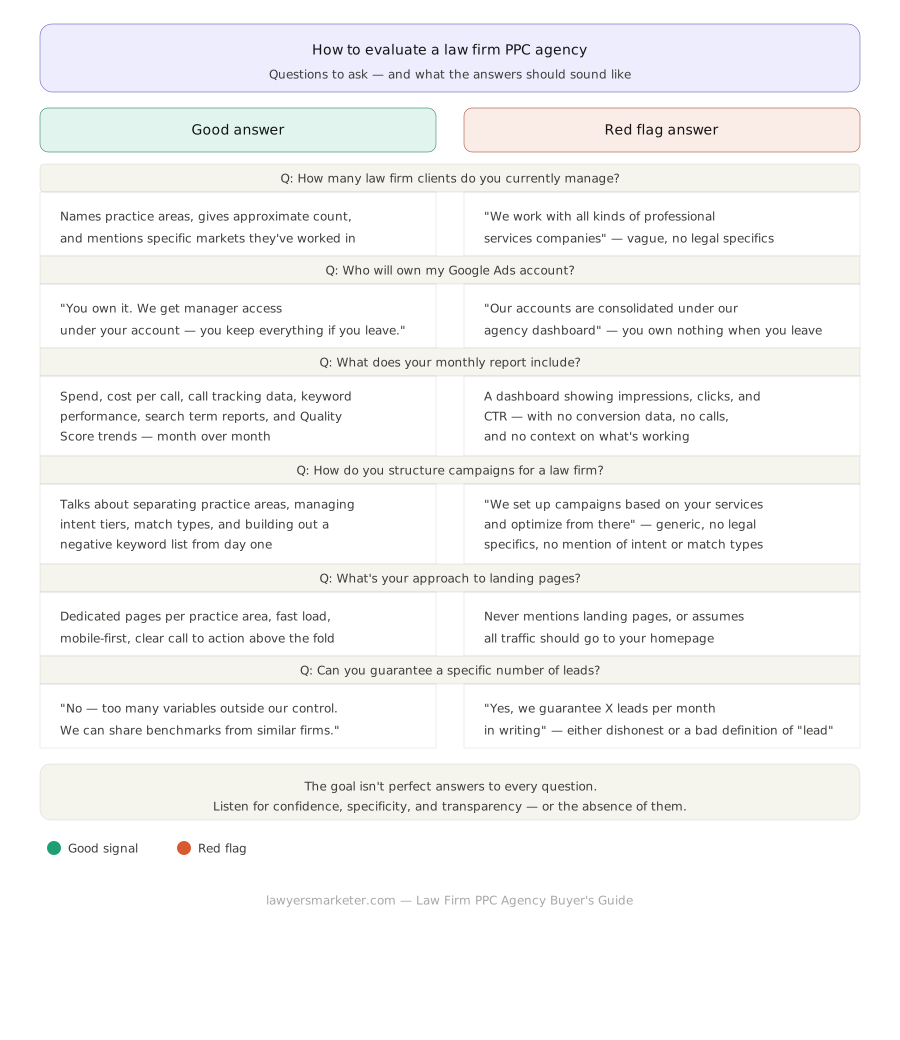
Here is a practical framework you can use when you are talking to agencies. These are not trick questions. They are questions with specific right answers, and a qualified agency should answer most of them without hesitation.
Ask About Their Legal Clients
Start here. Ask how many law firm clients they currently manage, what practice areas they have experience with, and whether they have clients in your geographic market. If they are reluctant to share this or give vague answers, that tells you something.
A good follow-up: “Can you give me a rough sense of the average monthly spend of your law firm clients?” This will help you understand whether your budget fits their model, and whether they have real experience at your spending level.
Ask How They Structure Campaigns
You do not need to understand every technical detail here. You are listening for whether they think in terms of audience and intent segmentation, or whether they talk about campaigns in generic terms. An agency with real legal PPC experience will naturally talk about separating practice areas, managing geographic targeting carefully, and building out negative keyword lists from the start.
If their answer is “we set up the campaign based on your services and then optimize from there,” that is generic enough to be concerning.
Ask What Their Reporting Looks Like
This is one of the most revealing questions you can ask. Request to see a sample report or ask them to walk you through exactly what metrics they track and report on each month.
A reporting package for a law firm PPC campaign should include, at minimum:
- Total spend for the period
- Impressions, clicks, and click-through rate
- Average cost per click by campaign
- Total conversions (calls + forms)
- Cost per conversion
- Call tracking data with call volume and duration
- Quality Score trends
- Search term reports showing what searches actually triggered your ads
What separates good from great: a genuinely excellent agency will also report on consultation-to-signed-client ratios if you share that data with them. They should be interested in downstream outcomes, not just traffic metrics.
If an agency’s default reporting is an ads dashboard with impressions and clicks and not much else, you are looking at an agency that is not accountable to what actually matters.
Ask Who Owns the Ad Account
This is a contractual question that catches a lot of firms off guard. There are agencies that build your Google Ads account under their own agency account. When you leave, you leave without your campaign history, your conversion data, and all the optimizations built over months or years.
Your ad account should be owned by your firm, in your own Google account. The agency should have manager-level access. If an agency is resistant to this arrangement, walk away.
Ask How They Handle Changes to Your Campaigns
You want to understand their process. How quickly do they respond if you need to pause spend, add a new service, or update messaging after a case result? Do they have a dedicated point of contact, or does your request go into a support queue? How often do they proactively reach out to you vs. waiting for you to ask?
Agencies that are spread thin tend to be reactive. You want one that is proactive enough to catch issues before they become expensive.
Ask About Their Approach to Quality Score
This is a mid-level technical question that weeds out agencies that are running campaigns on autopilot. Quality Score in Google Ads is a measurement of ad relevance, expected click-through rate, and landing page experience. A low Quality Score means you are paying more per click than competitors with better-structured campaigns.
A good agency should be able to explain the three components of Quality Score and describe how they improve it over time. If they look at you blankly, they are probably not doing the work required to make your budget go as far as it should.
Red Flags to Watch For
These are the warning signs that a law firm PPC agency is either inexperienced, misaligned with your interests, or both.
No legal-specific clients or case studies.
This is the biggest one. If an agency cannot show you law firm clients or results from the legal vertical, they are learning on your budget.
Percentage of ad spend pricing with no performance accountability.
This pricing model, which we will cover in more detail below, creates a conflict of interest. The agency makes more money the more you spend, regardless of whether that spending is generating cases.
Vague or infrequent reporting.
Monthly reports that show impressions and clicks without any conversion data are not useful. If an agency is not tracking calls as conversions, they are missing the most important metric in legal PPC.
They own your ad account.
Already mentioned above, but worth repeating. If your campaigns live in their account and you have no direct access to your own Google Ads account, that is a red flag.
No mention of landing pages.
If an agency talks exclusively about campaign structure and never brings up where traffic is going, they are leaving conversion performance on the table.
Guarantees of specific results.
No honest agency guarantees a specific number of leads or a specific cost per lead. There are too many variables outside their control. Agencies that make these guarantees are either not being truthful or they will redefine the metrics later to claim success.
They rely entirely on Google’s automated recommendations.
Google’s in-platform recommendations are designed to increase spend, not efficiency. A good agency evaluates and often declines these suggestions. If an agency’s optimization strategy is to apply Google’s recommendations, that is a concern.
No transparency on what they are actually doing.
If you ask your agency what they worked on last month and they cannot give you a specific answer, that is a problem. You should be getting a clear account of what was changed, tested, or optimized.
What Good Reporting Looks Like
Let’s go a level deeper on reporting because it is where the accountability actually lives.
A well-run law firm PPC program should produce a monthly report that lets you answer one core question: is this spending generating signed clients, and at what cost?
Here is what a complete reporting structure looks like for a law firm.
Top-line metrics.
Total spend, total clicks, total calls (tracked through call tracking software like CallRail), total form submissions, total consultations booked, and total new clients signed. Not every agency will have access to the downstream data on consultations and clients without your help, but the best ones will ask for it and build a reporting structure around it.
Campaign-level breakdown.
You should be able to see performance broken down by campaign, by practice area, and by geography. A personal injury campaign and a family law campaign should be reported separately, because they have completely different economics.
Keyword-level data.
Your report should include which keywords are generating conversions and at what cost, not just which keywords are generating clicks. This distinction matters a lot. Clicks are cheap to generate if you do not care about quality.
Search term reports.
These show the actual searches that triggered your ads. Reviewing these regularly is how you find irrelevant traffic and expand your negative keyword list. An agency that never shows you search term reports is either not reviewing them or hiding inefficiency.
Call tracking detail.
How many calls came in, what was the average duration, how many connected vs. went to voicemail, and which campaigns generated which calls. If your agency is not using call tracking integrated with Google Ads, they are flying blind.
Quality Score and impression share.
These give you a sense of competitive position. Impression share tells you what percentage of eligible impressions your ads are actually showing for. A low impression share might mean your budget is too small, your bids are too low, or your quality scores need work.
Month-over-month trend lines.
Good reporting is not just a snapshot of one month. It shows you directional movement on cost per lead, impression share, and Quality Score over time.
Law Firm PPC Pricing: What to Expect
Pricing in the law firm PPC agency space follows a few different models. Understanding the differences will help you evaluate whether what you are being quoted is reasonable.
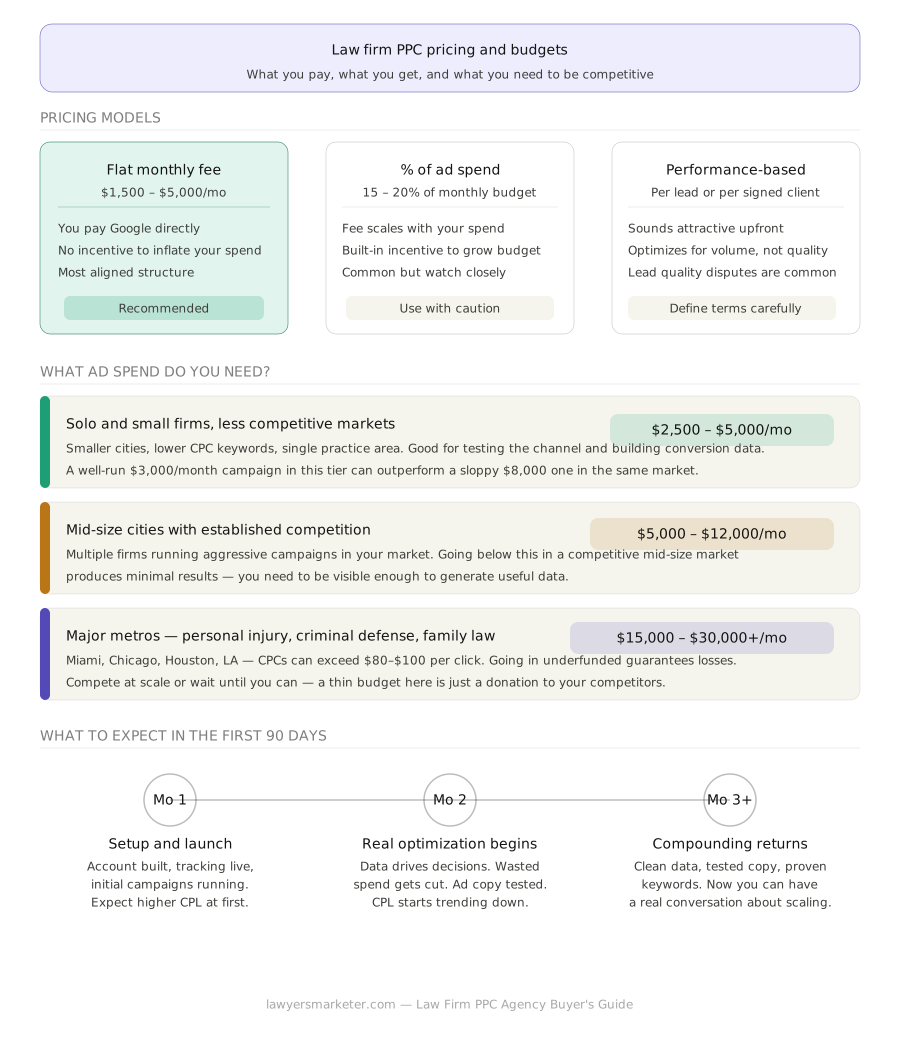
Flat Monthly Management Fee
This is the most straightforward model and, for most law firms, the most aligned with your interests. You pay a fixed monthly fee for campaign management, and your ad budget is separate. You pay Google directly for your clicks.
Typical range: $1,500 to $5,000 per month in management fees, depending on the agency and scope of work.
For smaller firms with budgets under $5,000/month in ad spend, you will typically be at the lower end. For firms spending $15,000+ per month, you should expect to pay more for a senior-level agency that can handle that scale.
The flat fee model means the agency has no financial incentive to inflate your spend. Their job is to make your budget as efficient as possible.
Percentage of Ad Spend
This model charges a percentage of whatever you spend on ads, typically 15 to 20 percent.
The issue here is structural. If you spend $10,000/month on ads, the agency makes $1,500 to $2,000. If they recommend you increase spend to $15,000, they make $2,250 to $3,000. Their revenue goes up whether or not the additional spend is productive. This creates an incentive to push for higher budgets regardless of performance.
That does not mean every agency using this model is acting in bad faith, but it is worth being aware of the dynamic. If you are on this model, insist on transparent reporting and a clear discussion about when budget increases are justified.
Performance-Based Pricing
Some agencies charge based on leads generated rather than a flat fee. On paper, this sounds attractive. In practice, it creates its own problems.
Agencies on a per-lead model have an incentive to optimize for volume over quality. A high-volume, low-quality lead strategy is not what a law firm needs. You need fewer, better leads that actually convert to consultations and signed clients.
Performance-based pricing also creates disputes about what constitutes a lead. A call that lasted 45 seconds and went nowhere is technically a lead if the agency defined it as a phone call. Be very precise about definitions if you consider this model.
Hybrid Models
Some agencies combine a base management fee with a performance component. For example, a $2,000/month flat fee plus a bonus per signed client over a baseline. Done well, this can be a genuinely aligned structure. The agency has stable revenue to do the work, and an incentive to care about downstream outcomes.
If you are evaluating this model, make sure the definitions and tracking are airtight before signing. Law firm marketing pricing should be tailored to your individual situation, not a rigid set of offerings that are the same for every client.
What Budget Do You Actually Need?
This is a common question that does not have a single right answer, but there are useful benchmarks.
Solo and small firms in less competitive markets:
$2,500 to $5,000/month in ad spend is a reasonable starting point. You can test the channel, gather conversion data, and start building keyword intelligence without overcommitting.
Firms in mid-size cities with established competition:
Plan for $5,000 to $12,000/month in ad spend to be competitive. If you are entering a market where several firms are spending aggressively, a minimal budget will produce minimal results.
Firms in major metros competing for high-value keywords:
Personal injury and criminal defense in cities like Miami, Chicago, or Houston require $15,000 to $30,000+ per month to compete at a meaningful level. Going in underfunded in these markets is a guaranteed way to lose money.
One thing to be cautious about: agencies that take on law firm clients with budgets that are too small for the market. If you have $2,000/month to spend on ads in a market where clicks cost $80 each, that is 25 clicks per month, which is not a real test of anything. A good agency will tell you that honestly rather than taking your money.
Questions to Ask Before You Sign
Here is a consolidated list you can bring into any agency conversation.
- How many law firm clients do you currently manage, and in what practice areas?
- Can you share case studies or performance benchmarks from your legal clients?
- Who will own my Google Ads account, and will I have direct admin access?
- What does your standard monthly report include?
- How do you track calls, and what call tracking software do you use?
- How do you structure campaigns for a law firm with multiple practice areas?
- What is your process for building and maintaining a negative keyword list?
- How do you approach landing pages? Do you build them or do we need to handle that?
- What is your response time when I need something changed quickly?
- How often will we have a strategy call, and who will I be talking to?
- What results have you seen from campaigns similar to mine?
- What happens to my account if I decide to stop working with you?
You do not need perfect answers to all of these. You are listening for confidence, specificity, and transparency. An agency that hedges on account ownership or gets vague about reporting is showing you who they are.
The Difference Between a Good Law Firm PPC Agency and a Great One
Most agencies in this space can run a passable Google Ads campaign. The gap between good and great is what they do beyond the basics.
A great law firm PPC agency integrates your paid search with your broader marketing picture. They understand how PPC and SEO work together, how your Google Business Profile affects your Local Services Ads performance, and how changes in your market affect your campaign strategy.
They bring you insights rather than waiting for you to ask. If a competitor drops out of the auction and your impression share suddenly jumps, a great agency notices and tells you. If your landing page conversion rate drops, they flag it before you see it in your call volume.
They think about your cost per signed client, not just your cost per click. The whole point of paying for ads is to generate revenue. An agency that never asks about your close rate and average case value is not thinking about your business the right way.
They are honest when things are not working. That means telling you when your budget is too small for your market, when a practice area is too competitive to run profitably at your current spend level, or when the problem is not the ads but the intake process.
Working With a Law Firm PPC Agency: What to Expect in the First 90 Days
A lot of firms get frustrated in the first 90 days because their expectations are not calibrated correctly. Here is what a realistic timeline looks like.
Month one is almost always a setup and learning period. The agency is building the account structure, setting up tracking, launching initial campaigns, and gathering data. Your cost per lead in this period is typically higher than it will be at steady state, because the campaigns are not yet optimized.
Month two is when real optimization begins. The agency has enough data to identify which keywords are converting, which ad copy is working, and where budget is being wasted. You should see cost per lead trending down.
Month three and beyond is where compounding returns start to show. A well-managed account that has been running for three months has clean data, tested ad copy, a built-out negative keyword list, and a track record of what works. This is when you can have an informed conversation about scaling spend.
If an agency promises spectacular results in 30 days, be skeptical. PPC can produce fast results, but smart PPC takes a few months to dial in properly.
A Note on Local Services Ads vs. Traditional PPC
Many law firms running Google Ads are also running Local Services Ads, which is Google’s pay-per-lead product for legal (and other professional) categories. They show at the very top of search results with a “Google Screened” badge.
Local Services Ads and traditional PPC are different products with different mechanics, and a qualified law firm PPC agency should understand both. Traditional PPC gives you much more control over targeting, bidding, and messaging. Local Services Ads are simpler but less controllable.
The best strategy for most firms is to run both in parallel, optimizing each for what it does well. If an agency only talks about one and dismisses the other, ask them why.
Parting Thoughts On Law Firm Google Ads Agencies
Hiring a law firm PPC agency is a significant decision. Done right, paid search can be one of the most predictable lead generation channels a law firm can run. Done wrong, it is an expensive education.
The firms that get the best results from PPC share a few traits. They work with agencies that specialize in legal, not generalists who dabble in it. They insist on account ownership and transparent reporting. They have realistic budget expectations for their market. And they stay engaged with their campaigns rather than treating PPC as a set-and-forget expense.
If you are shopping for a law firm Google Ads agency, use this guide as your evaluation framework. Ask the hard questions, watch for the red flags, and hold the agency accountable to the metrics that actually matter: cost per consultation and cost per signed client.
If you want to talk through your specific situation, our team at The Lawyers’ Marketer works exclusively with law firms on paid search strategy. We would be happy to give you an honest assessment of what PPC could look like for your firm before you commit to anything. Contact us for a free, no obligation conversation about your PPC goals.