TL;DR
- AI Overviews are reshaping how PI searches work. Ranking #1 no longer guarantees clicks.
- Local Service Ads now sit above PPC and organic. If you’re not running them, you’re invisible on mobile.
- City pages alone are not enough anymore. Google wants depth, proof, and entity authority.
- E-E-A-T is table stakes in personal injury because Google treats PI as YMYL content.
- The firms winning right now combine LSA, GBP optimization, content silos, and structured data.
- There is no shortcut. This market is the most competitive in legal.
Personal injury is the most cutthroat practice area in legal SEO. Always has been. But something shifted in the last 18 months, and a lot of firms that were doing “fine” before are now watching their traffic quietly erode.
This guide breaks down what’s actually happening in the PI search landscape right now, not recycled advice from 2022. We’ll cover the AI Overview effect, how LSAs are rewriting the rules of the SERP, why your city pages aren’t pulling their weight, and what the top-performing PI firms are doing differently.
If you want a broader look at what a competitive PI marketing plan looks like beyond just organic search, our personal injury lawyer marketing guide covers the full picture. If you’re trying to figure out where your firm stands right now, a free law firm intake analysis is a good first step.
The PI SERP Has Changed. A Lot.
Here’s what the search results page looks like for a query like “car accident lawyer Miami” in 2025:
- Google Local Service Ads (LSA) carousel, usually 3 to 4 firms
- Traditional Google Ads
- Google Map Pack (3 local listings)
- Organic results, starting around the fold on mobile
Notice what’s not at the top? Your organic ranking. Even if you’ve been grinding on SEO for three years and landed a page one spot, you’re often showing up after ads, LSAs, and the map pack. On a phone, which is where most accident victims search from, that organic position is below the fold entirely.
Four or more LSAs can push organic listings completely below the fold, reducing the visibility of even highly optimized personal injury law firm websites.
That’s the reality. It doesn’t mean SEO is dead. It means SEO alone is not the strategy anymore. It’s a layer in a broader system.
What AI Overviews Are Doing to Personal Injury Lawyer SEO Traffic
In 2024 and 2025, Google transformed its search experience by layering advanced AI directly into search results, including AI Overviews and AI Mode. These features use large language models to summarize information, answer complex queries, and help users get answers faster than traditional blue links.
For personal injury lawyers, this plays out in a specific way. Informational queries like “what should I do after a car accident” or “how long does a PI case take” are getting swallowed by AI-generated answers. The user gets a summary, maybe clicks a cited source, and never scrolls to organic.
Independent industry analysis shows AI summaries reduce click-through rates on traditional links, with some research finding nearly 30 to 35 percent declines in clicks when AI Overviews are present.
That said, commercial queries (“car accident lawyer near me”) still produce click-heavy results. The issue is that even for those queries, Google’s AI can pull an immediate answer, citing a few trusted sources. If your firm isn’t one of them, you don’t even make the short list.
So the goal has expanded. You’re not just trying to rank. You’re trying to be the source that AI cites, summarizes, and recommends. This is what’s commonly called GEO (Generative Engine Optimization) or AEO (Answer Engine Optimization).
GEO is the practice of optimizing your firm’s content so it is referenced, summarized, and cited by AI-driven search engines like Google AI Overviews, ChatGPT, Perplexity, and other large language models. Unlike traditional SEO, GEO is not just about rankings. It’s about being the source AI systems trust and quote.
How do you do that? A few ways:
Structured content. Write content that answers specific questions clearly and directly. No fluff intro. No long preamble. Answer the question, then add context. AI pulls from pages that are easy to parse.
Schema markup. FAQ schema, Article schema, Attorney schema, LegalService schema. These help AI systems understand who you are, what you do, and where you do it.
Authoritative sourcing. When you cite local accident stats, court case timelines, or state statutes, you signal that your content is grounded in verifiable fact. AI systems prefer content that plays like a reference document, not a blog post.
E-E-A-T signals. More on this below. For PI specifically, these are weighted heavily because personal injury is a YMYL category.

Local Service Ads: The Channel PI Firms Can’t Ignore
This is where a lot of firms are leaving money on the table.
LSAs occupy the most valuable real estate in Google search results, the very top of the page, above traditional pay-per-click ads and organic listings. When someone in your area searches for “personal injury lawyer near me,” Google shows a carousel of verified local firms.
The model is different from PPC. You pay per lead, not per click. And you can dispute bad leads. For PI firms used to paying $200 to $500 per click in Google Ads, LSA can be a dramatically more efficient channel.
But LSA rankings don’t work the way you might expect. Google prioritizes proximity to the searcher above everything else. After proximity, the two primary differentiators are review volume and response speed.
Every missed LSA call or unaccepted lead signals to Google that you provide a poor user experience. Google will immediately reduce your ad visibility and lower your rank, prioritizing competitors who answer their phones.
In other words, your intake system is now an SEO factor. A firm with mediocre content but a great intake operation can outrank a firm with great content but slow response times in the LSA carousel.
A few specifics to get right:
- Profile completeness. Your LSA profile and GBP should be synchronized. Same name, same hours, same attorney headshots.
- Reviews. LSA-verified reviews (from clients who called through the ad) carry the most weight. Build a system to ask for these after every retained case.
- Lead acceptance rate. Accept or dispute every lead promptly in the LSA dashboard. This is a direct ranking signal.
- Case type targeting. Each additional case type you select dilutes your budget across more searches and brings in lower-quality leads. If you’re primarily an auto accident firm but also select medical malpractice, you’ll get expensive med mal leads you’re not equipped to evaluate or handle.
LSA is not replacing personal injury lawyer SEO. But if you’re treating them as separate strategies, you’re operating less efficiently than firms that understand how they intersect. Strong organic rankings and GBP authority appear to support LSA performance. Attorneys with robust organic SEO tend to rank higher in the local pack, and referring do-follow domains, site traffic, and overall web presence all appear to impact Google Business Profile position.
This relationship goes both ways. A healthy GBP boosts local SEO. Local SEO authority reinforces LSA visibility.
For a deeper look at how paid channels fit into law firm marketing, see our law firm PPC services page.
Why City Pages Alone Are Not Enough Anymore
Five years ago, you could build 30 city pages targeting “personal injury lawyer [city],” drop in some unique content for each, and rank across a region. That model is largely broken now.
Google got better at detecting low-value location pages. If your Chicago page and your Milwaukee page are functionally the same content with the city name swapped, Google treats them as thin. You may get indexed. You won’t rank. This has changed personal injury lawyer SEO efforts (for all the marketers who are paying attention…many are asleep at the wheel).
The second problem is that even well-written city pages are one-dimensional. They target a geography but don’t demonstrate depth within a practice area. And in personal injury, Google wants depth.
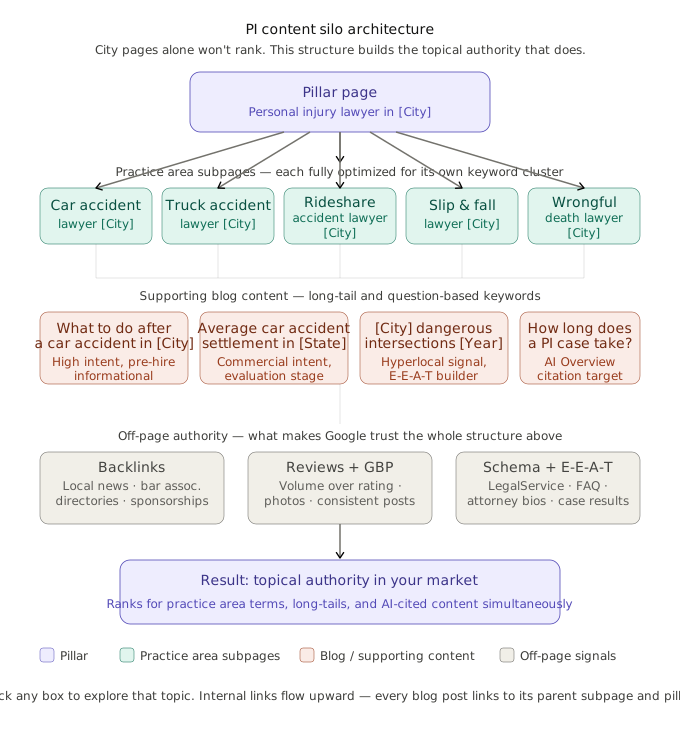
The firms ranking well in 2025 are using content silo architecture. The idea is to build topical authority, not just local coverage.
Here’s what that looks like in practice:
Pillar page: Personal Injury Lawyer in [City] (main page, targets your primary geography and keyword)
Subtopic pages underneath it:
- Car Accident Lawyer [City]
- Truck Accident Lawyer [City]
- Rideshare Accident Lawyer [City] (Uber/Lyft)
- Slip and Fall Lawyer [City]
- Wrongful Death Lawyer [City]
- Motorcycle Accident Lawyer [City]
- TBI and Catastrophic Injury [City]
Supporting blog content:
- What to Do After a Car Accident in [City]
- [City] Dangerous Intersections: Car Accident Data [Year]
- How Long Does a PI Case Take in [State]
- What Is My Car Accident Case Worth?
- [City] Hit-and-Run Accidents: What You Need to Know
When these pages are properly interlinked and each one answers real questions from real injury victims, you create topical authority that city pages alone can never build.
A generic “Personal Injury” page will never rank for specific, high-intent searches. You need a silo architecture that proves your specialized expertise in every sub-niche.
The other dimension city pages miss is local specificity. Not just naming the city, but embedding real local context. If you’re discussing motorcycle accidents, talk about the most dangerous roads and intersections in your local market. Include reviews and testimonials specific to the practice area. Make sure content is unique across multiple locations.
This is harder to produce at scale. But that difficulty is exactly what creates the competitive moat.
E-E-A-T and Why It Hits Harder in Personal Injury
Personal injury is classified by Google as a YMYL topic, meaning “Your Money or Your Life.” This category gets extra scrutiny from Google’s quality raters and, increasingly, from its ranking algorithms. It’s an area that deserves some special attention in personal injury lawyer SEO.
For practice area pages, demonstrating real-world experience through proven case results and detailed attorney bios is essential. Google and other search engines favor authoritative E-E-A-T content, making this the only way to outrank AI-generated thin content.
E-E-A-T stands for Experience, Expertise, Authoritativeness, and Trustworthiness. Here’s how each plays out specifically for PI firms:
Experience means demonstrating that real attorneys with real case history are behind the content. This is why generic AI-generated content is losing ground in this space. Google’s ability to detect it has improved, and even when it can’t detect it outright, the lack of specific case results, specific attorney credentials, and local specificity signals thin content.
Expertise means your content reflects genuine legal knowledge. Not just definitions of terms, but nuanced explanations of how PI cases work in your state, how comparative negligence applies, what the statute of limitations is, and what factors affect case value.
Authoritativeness is largely built through backlinks and mentions. Getting cited in local news articles, in bar association directories, in legal publications, or in community resources all build this signal. For personal injury lawyers, an authority score of 20 to 30 is usually the minimum needed to rank on page one, and this varies significantly by how competitive your local market is.
Trustworthiness comes from signals like verified client reviews, bar association listings, transparent attorney bios with photos, and a secure, fast-loading website. It also comes from accurate NAP (name, address, phone) consistency across directories.
A practical checklist for E-E-A-T in PI:
- Every practice area page has a named attorney author with a bio and photo
- Case results are featured prominently (with appropriate disclaimers)
- Reviews from verified clients appear near the top of practice area pages
- Content cites local statutes, court rules, and verifiable data
- Bar association and legal directory profiles are current and link back to your site
- Your Google Business Profile is fully built out with 50 or more photos and consistent posting
Our law firm SEO services page walks through how we approach E-E-A-T and content architecture for PI clients specifically.
The Keyword Strategy That’s Working Right Now
Broad keywords like “personal injury lawyer” are dominated by national firms, major directories (Avvo, Justia, FindLaw), and aggregators with decades of domain authority. If you’re a regional PI firm, going after these broad terms as your primary strategy is a slow road to nowhere.
What’s working instead is a combination of:
High-specificity practice area keywords: “rideshare accident lawyer Chicago,” “18-wheeler accident attorney Dallas,” “TBI attorney Houston.” These have lower search volume but dramatically higher intent, lower competition, and often lower cost per click when paired with Google Ads.
Long-tail question keywords: “how much does a personal injury lawyer cost,” “how long do I have to sue after a car accident in Florida,” “what happens if I was partially at fault.” These feed into AI Overview citation eligibility and can drive substantial informational traffic that converts at the bottom of the funnel.
Verdict and settlement keywords: “average car accident settlement in [state],” “[city] truck accident verdict.” These are searched by people evaluating whether to hire a lawyer, which puts them in a strong commercial intent window.
Process-oriented searches: “personal injury case timeline,” “how does contingency fee work,” “what to bring to PI lawyer consultation.” These are pre-hire intent searches from people who are close to making a decision.
Local personal injury lawyer SEO is no longer about city plus keyword. It’s about understanding how real people search when they’re in pain, panicked, and ready to call.
Using tools like Ahrefs, Semrush, or even Google’s own “People Also Ask” boxes to surface these specific variations will get you further than chasing volume on competitive head terms.
One keyword set worth prioritizing right now: sub-specialty terms. As PI becomes more competitive at the broad level, terms like “dog bite attorney,” “premises liability lawyer,” “construction accident attorney,” and “nursing home abuse lawyer” are increasingly winnable for firms with domain authority in the 25 to 40 range.
Technical SEO: The Foundation That Can’t Be Ignored
This section isn’t glamorous. But it’s where a surprising number of PI sites are losing ground.
Page speed.
If your site takes too long to load, visitors bounce. If it’s hard to navigate on a small screen, they give up. If there’s no click-to-call button, they call someone else. In personal injury law, those few seconds often determine which firm gets the case. Core Web Vitals are a ranking factor. Use Google’s PageSpeed Insights to benchmark yours. Anything below 70 on mobile is a problem worth fixing before you publish another blog post.
Mobile-first indexing.
Google indexes the mobile version of your site first. This means your mobile experience is your SEO experience. If your full site navigation collapses on a phone or your practice area pages render poorly on a 5-inch screen, that’s hurting you in ways that content can’t fix.
Site architecture and internal linking.
Your pillar page should receive internal links from every related subtopic and blog post. These signals tell Google which pages you consider most important and help consolidate authority. Many PI sites have great content with terrible internal linking, which wastes the authority they’ve built.
Schema markup.
Use LegalService schema on practice area pages. Attorney schema on bio pages. FAQ schema on pages with question-and-answer content. Review schema where reviews appear. These aren’t guaranteed ranking boosts but they help AI systems understand your content and increase your chances of appearing in rich results.
Crawl and index hygiene.
Use Google Search Console regularly. Make sure important pages are indexed. Check for duplicate content issues, especially if you’ve built out multiple city pages. Canonical tags and proper redirect handling matter more in PI than people realize.
Backlinks: Still the Hardest Thing to Fake
In a market as competitive as personal injury, your backlink profile is often the deciding factor between ranking on page one and ranking on page two. The difference in traffic between those two positions is not small. Personal injury lawyer SEO doesn’t work without some effort to build backlinks.
The link types that move the needle for PI firms:
Local news mentions.
A feature in your city’s newspaper or local TV station’s website carries serious authority and is highly relevant to local ranking. Become a resource for local journalists who cover accidents, insurance disputes, or safety issues.
Bar association and legal directory listings.
Avvo, Justia, FindLaw, etc. These are table stakes for any PI firm. Make sure your profiles are complete, current, and link back to your site.
Sponsorships and community involvement.
Sponsor a local charity event, a school safety initiative, or a nonprofit. These partnerships often result in links from high-trust local domains.
Guest content on legal and news publications.
Writing for legal publications or industry sites builds authority and can generate sustained referral traffic over time.
HARO and PR outreach.
When journalists are looking for legal commentary, being available positions you for mentions and links from news outlets.
What to avoid: link farms, paid link packages from grey-hat providers, irrelevant directory submissions, and any scheme that promises 50 links in 30 days. Google’s spam detection in YMYL categories is particularly aggressive. One manual penalty in PI can take years to recover from.
We go deeper on backlink strategy for law firms on our backlinks service page.
Google Business Profile: The Underrated Traffic Driver
Your GBP is not just a map listing. For many PI firms, it’s the highest-converting touchpoint in the entire marketing funnel.
A higher number of Google reviews correlates with higher positions in Google Maps listings. Greater numbers of photos in a Google Business Profile are strongly correlated with a higher position. Regular updates to a profile correlate with higher rankings.
Here’s what actually matters for PI firms based on available data:
Review volume.
Not rating average. Everyone in PI has 4.6 stars or higher. What differentiates you is having more reviews than your competitors, particularly recent ones. Consistently asking every satisfied client for a review should be a non-negotiable intake follow-up step.
Photos.
More than most firms think. GBPs with 100 or more photos receive dramatically more search views than the average listing. Post photos of your office, your team, your community involvement, and your case results announcements.
Posts and updates.
Posting regularly to GBP signals that you’re active. Use these to share blog content, announce case results, highlight community events you’re involved in, and publish seasonal safety content.
Keywords in your description and service areas.
Fewer than a quarter of attorneys surveyed included the keywords “lawyer” or “attorney” in their Google Business Profile title. This is a quick win. If your profile doesn’t mention the specific practice areas you handle, fix that today.
What A Winning Personal Injury Lawyer SEO Strategy Looks Like
For a PI firm serious about dominating their market in 2025, this is the layered approach that’s working:
Foundation
- Fast, mobile-optimized website
- Full technical SEO audit completed
- Schema markup installed across all page types
- NAP consistency across all directories
Local visibility
- GBP fully built out with 50 or more photos, consistent posting, and active review acquisition
- LSA profile live with proper case type selection and intake team briefed on response speed requirements
- Local citations built and maintained
Content architecture
- Pillar pages for each major practice area targeting your primary geography
- Subtopic pages for each injury type
- Supporting blog content targeting long-tail and question-based queries
- Internal linking structure directing authority toward money pages
Authority building
- Local news relationships developed
- Legal directory profiles complete and linking back to site
- Guest content pipeline established
- Community sponsorship links secured
AI and GEO readiness
- FAQ schema on all pages with Q&A content
- Content structured around direct, answer-first formatting
- Attorney bios and case results prominent on all practice area pages
This is not a quick-launch strategy. Most PI firms see meaningful organic movement at 6 to 9 months with consistent execution. LSA can produce leads much faster, often within weeks, which is why it makes sense to run both simultaneously.
How to Evaluate Your Current Personal Injury Lawyer SEO Situation
Before spending more on content or links, it’s worth knowing exactly where you stand. Common gaps we see in PI firm audits:
- High keyword count, low traffic (content targeting informational intent instead of commercial)
- Good rankings, bad conversion (no click-to-call, slow load speed, weak social proof)
- Strong organic presence, no LSA (missing the top-of-page opportunity entirely)
- Multiple city pages with duplicate content (diluting rather than building authority)
- Backlink profile dominated by low-value directories (no contextual authority)
If any of those sound familiar, contact us and we’ll start with a free law firm website audit. We’ll look at your current SEO health, your competitive landscape, and where the biggest gaps are. You can also check whether your intake process is keeping up with your marketing by requesting a free law firm intake analysis.
Personal injury lawyer SEO marketing rewards consistency, specificity, and patience. The firms that understand what’s changed with AI and LSA, and adjust accordingly, are the ones picking up cases that used to go to firms running the old playbook.
The Lawyers’ Marketer specializes in SEO, PPC, and content marketing for personal injury firms and law practices across the US. Learn more about our approach or get in touch to talk through what a competitive PI SEO strategy looks like for your market.