


TL;DR
- Content marketing for law firms means creating blog posts, guides, and practice area pages that attract potential clients through search engines
- A consistent publishing strategy builds long-term organic traffic that doesn’t stop working when your ad budget does
- The best law firm content targets what potential clients are actually searching for, not what attorneys want to write about
- Content works best when it’s paired with strong SEO fundamentals and backed by quality backlinks
- Most firms fail at content marketing because they publish inconsistently, write for other lawyers instead of clients, or treat it as an afterthought
What Law Firm Content Marketing Actually Is
Content marketing is not blogging for the sake of blogging. It is a deliberate strategy where you publish useful, search-optimized information that your potential clients are already looking for online, and then let that content work on your behalf around the clock.
For law firms, it looks like this: Someone in your city gets into a car accident and searches “do I need a lawyer after a fender bender.” They find an article on your site that answers their question. By the end of the article, they trust you. They book a consultation. You sign the case.
That is content marketing doing its job.
It is different from running Google Ads, where the traffic stops the moment you stop paying. Good content compounds over time. A blog post you publish today can generate leads for years if it ranks well and answers the right question.
Why Most Law Firm Content Fails
Walk through the blog section of almost any law firm website and you will see the same problems over and over.
Posts written in legalese that only another attorney would understand. Articles about firm news that no potential client cares about. Thin posts that say almost nothing. Content published once in a burst of motivation and then abandoned for six months.
None of that works. Here is why.
You are writing for the wrong audience.
When a potential client searches for information about their legal problem, they are scared, confused, and looking for clarity. They are not looking for a 500-word definition of negligence that reads like a law school textbook. Your content needs to speak like a trusted advisor, not a legal brief.
You are not publishing consistently.
Search engines reward websites that show up regularly with fresh, relevant content. A firm that publishes two solid posts per month will outperform a firm that publishes 20 posts in January and then goes silent.
You are not targeting what people actually search for.
This is the biggest mistake. Attorneys tend to write about what interests them professionally. Potential clients search for solutions to their specific problems. The gap between those two things is where content marketing dies.
The Content Types That Actually Generate Cases
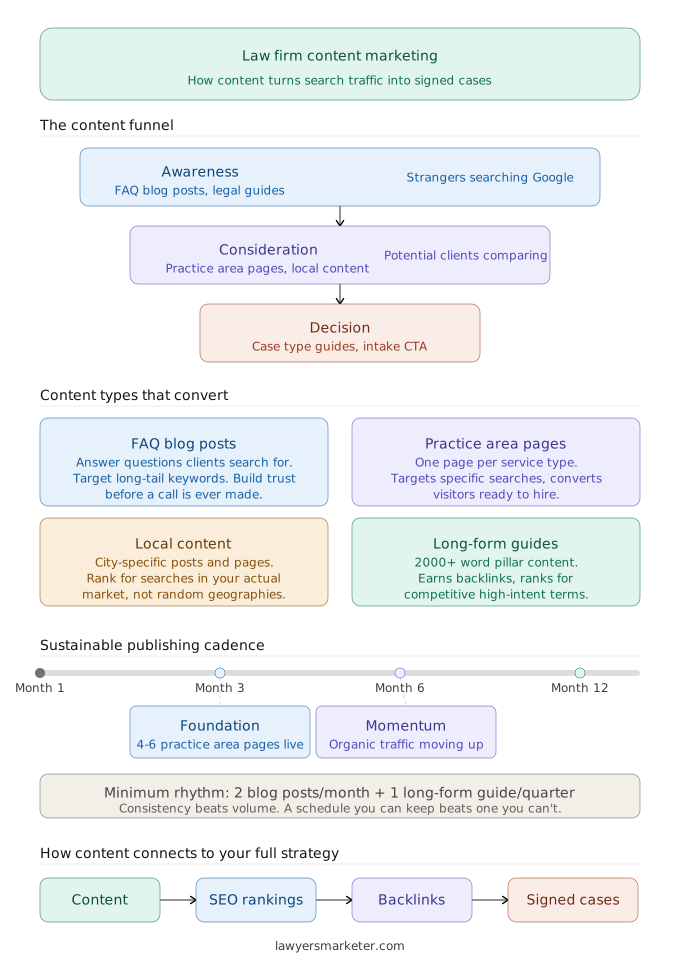
Not all content is created equal. For law firms, a handful of formats consistently outperform everything else.
Practice area pages.
These are the foundation. If you handle family law, you need a dedicated page for divorce, another for child custody, another for adoption. Each one targets a specific search term and speaks directly to someone facing that situation. These are not blog posts. They are conversion-focused service pages that explain what you do, who you help, and how to reach you.
FAQ-style blog posts.
Think about the questions potential clients ask during consultations. “How long does a divorce take in Florida?” “What happens if I refuse a breathalyzer test?” “Can I sue my employer for wrongful termination?” Every one of those questions is a blog post. Every one of those blog posts is a potential client finding you through Google.
Local content.
If you practice in a specific city or metro area, create content that speaks to that geography. “DUI attorney marketing in Tampa” converts better than a generic article about DUI defense because the person searching it is in your market, looking for someone like you.
Case type guides.
Long-form guides that walk through a legal process from start to finish position your firm as the authoritative resource in your practice area. They also tend to attract links from other sites, which strengthens your SEO. A 2,000-word guide on “What to do after a truck accident in Texas” can generate leads for years.
How Law Firm Content Marketing Fits Into a Bigger Strategy
Content marketing does not exist in a vacuum. It works best when it is part of a complete law firm marketing strategy.
Here is how the pieces connect.
Content and SEO are inseparable.
You can write excellent content that nobody ever reads because it was never optimized for search. Keyword research needs to happen before you write, not after. Every piece of content should target a specific search term that real potential clients are using. If you are not sure how your SEO and content stack up right now, a free law firm website audit is a good place to start.
Backlinks amplify everything.
When other authoritative websites link to your content, Google treats your site as more credible and pushes your rankings higher. This is why building backlinks for law firms is so important. Great content is one of the best ways to earn those links organically, because people share and reference information that actually helps them.
PPC can extend the reach of your best content.
Some law firms run paid ads to their top-performing blog posts and guides to accelerate their exposure while organic rankings build up. This is a legitimate strategy, especially in competitive markets. If you are weighing how to allocate budget between content, SEO, and paid ads, a law firm PPC agency that understands legal advertising can help you prioritize.
A Realistic Content Calendar for Law Firms
You do not need to publish daily to build momentum. Here is a sustainable cadence that most firms can maintain.
Two blog posts per month minimum. One targeting a high-value FAQ keyword, one targeting a local or practice-area-specific term. Four to six practice area pages built out over the first 90 days. One comprehensive long-form guide per quarter on a cornerstone topic in your practice area.
That is a manageable workload that compounds over time. After 12 months of consistency, most firms see meaningful organic traffic growth. After 24 months, the results tend to speak for themselves.
What kills momentum is trying to do too much up front and burning out. Start with a schedule you can actually keep.
What to Measure
Content marketing has a reputation for being hard to measure, but that reputation is mostly undeserved if you are tracking the right things.
Organic traffic to specific pages tells you whether your content is getting found. Time on page tells you whether people are actually reading it. And at the bottom of the funnel, form submissions and phone calls tell you whether the content is converting. Google Analytics and Google Search Console give you most of what you need for free.
The metric that matters most is signed cases. If you are publishing content, getting traffic, and not signing cases, the problem is usually in the call to action or the intake process, not the content itself. That is worth a separate look at your intake process.
Parting Thoughts on Law Firm Content Marketing
Content marketing is not a quick fix. It is not going to replace your PPC campaigns next month. But over time, it is one of the most cost-effective ways to build a consistent pipeline of potential clients who found you because you gave them something useful before they ever called.
The firms that invest in content consistently, optimize it properly, and pair it with solid SEO end up in a position their competitors cannot easily replicate. Rankings are hard to steal. Authority takes time to build. But once you have it, it works for you.
If you want to talk through a law firm content marketing strategy for your firm, we’re easy to reach.