
TL;DR
- Solo and small criminal defense firms compete differently than big shops. Your strategy needs to reflect that.
- Referral networks are often more valuable than paid ads, especially in years one through three.
- Google Business Profile and local SEO are your highest-ROI starting points before you touch Google Ads.
- Positioning against public defenders (not just other private attorneys) is an underused angle that converts well.
- Budget allocation looks very different at $1,500/month versus $8,000/month. This guide covers both.
Most criminal defense marketing guides are written with mid-size or large firms in mind. They recommend $10,000/month ad budgets, full marketing teams, and elaborate content strategies that would take a solo attorney six months just to understand.
That is not useful if you are a solo practitioner running a one-person shop in a mid-size city, or a two-to-four attorney firm trying to grow without a dedicated marketing hire.
This guide is written for you. Not as a watered-down version of enterprise legal marketing advice. As a genuinely different playbook that fits your constraints, your client pipeline, and how criminal defense clients actually make hiring decisions.
Why Criminal Defense Marketing Is Different From Other Practice Areas
Before getting into tactics, it helps to understand what makes this practice area unusual from a marketing standpoint.
Criminal defense clients are often in crisis mode. They are not doing careful, weeks-long research before hiring. They or a family member just got arrested, or they received a target letter, or they are about to face a hearing. They need someone fast. The decision window is short and the emotional stakes are high.
That changes how people search, what they read, and what makes them pick up the phone.
It also means they are often searching at night, on weekends, and in moments of panic. A firm that has a good Google Business Profile, a website that loads fast on mobile, and a phone that gets answered (or quickly returned) will beat a fancier firm that has none of those basics locked in.
The other thing that sets criminal defense apart: the client has already had a negative experience with the government. They may have distrust of authority baked in at this moment. Your marketing messaging needs to project someone who fights, not just someone who processes cases. That is a positioning choice that many firms miss.
The Solo vs. Small Firm Divide
There is a meaningful difference between how a solo criminal defense attorney should approach marketing and how a firm with two, three, or four attorneys should.
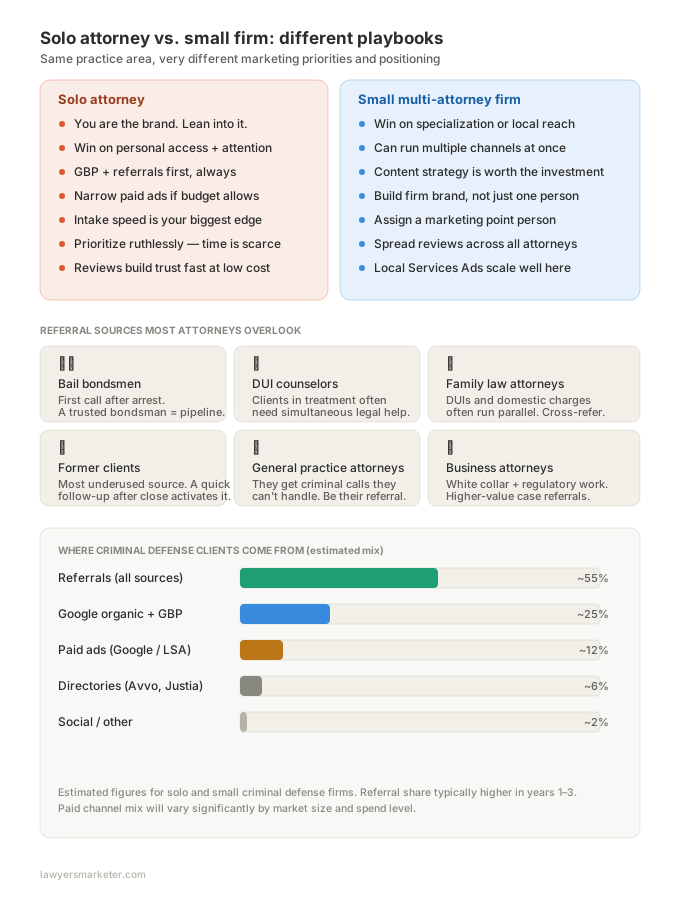
The solo attorney is the brand. Clients are hiring you specifically. Your face, your story, your track record, and your accessibility are the product. Marketing that hides you behind a corporate-looking website actually works against you. Lean into being a person. Clients often prefer a solo precisely because they feel they will get more direct access and personal attention.
The challenge for solos is time. You are doing the legal work and the business development. That means you need to prioritize ruthlessly. You cannot do everything. The right answer is almost always: get your local SEO dialed in, build your referral network consistently, and run a narrow, well-targeted Google Ads campaign if budget allows. That is it. Everything else is distraction until you have those three working.
The small multi-attorney firm has different dynamics. You can start to build something more scalable because you have a little more capacity. You can delegate marketing tasks. You can build a real content library. You can run more aggressive paid campaigns. But you also face a positioning challenge: you are not big enough to win on authority alone, and you are not small enough to win on the “personal attention” angle a solo can use.
Small firms usually win on a combination of specialization (you are known for a specific type of case), local presence (you are THE firm in your county or city), and reputation (reviews, word of mouth, and referrals that have compounded over time).
Both solo and small firm marketing share one common thread: the budget and team size mean you have to be efficient. You cannot buy your way into the market the way a large firm can. Every dollar and every hour needs to work.
Realistic Budget Allocation for Criminal Defense Firms
Here is where most marketing guides fail solo and small firms. They give advice that only makes sense at much higher budgets.

Let us break this down honestly.
Starting budget: $1,000 to $2,500/month
At this level, your priorities are:
- Google Business Profile optimization (free, but time investment required)
- A solid website with conversion-focused landing pages for your main practice areas (DUI, drug charges, assault, etc.)
- Basic local SEO: citation building, consistent NAP, location-specific content
- Avvo and Justia profile optimization (free or low cost)
- Active referral cultivation (also free, but intentional)
Paid ads at this budget level are risky unless you are extremely precise with targeting. Criminal defense keywords like “criminal defense attorney [city]” and “DUI lawyer near me” can run $20 to $80 per click in competitive markets. You can blow through $1,500 in a week with nothing to show for it if the campaigns are not set up correctly.
If you are in a smaller market, you have more room to run paid ads at lower budgets. If you are in a major metro, wait until you have more.
Growth budget: $2,500 to $5,000/month
Now you can add:
- Google Ads with tightly themed ad groups for specific charges (DUI, drug offenses, domestic violence, federal charges, etc.)
- A Google Local Services Ads profile (if available in your market)
- Basic content marketing: two to four blog posts per month targeting local and practice-area keywords
- Possibly a legal directory like FindLaw or Lawyers.com, but vet the ROI carefully first
Scaling budget: $5,000 to $10,000/month
At this level, small firms can start to run more aggressive campaigns:
- Broader Google Ads coverage with remarketing
- YouTube or Meta ads for awareness (these rarely convert directly but can support your brand in search)
- A more systematic content strategy targeting long-tail keywords
- Consistent video content (case explainers, FAQ videos, attorney profiles)
- Call tracking with a tool like CallRail to understand which channels are actually driving cases
One note on call tracking: if you are spending any real money on paid ads and you do not have call tracking set up, you are flying blind. You have no way to know which campaigns are producing calls. This is a basic infrastructure investment that pays for itself quickly.
The Referral Network: Still the Best ROI for Criminal Defense
Many digital marketing guides skip over referral network building because it is not a product they sell. But for criminal defense, referrals are often where the best cases come from, and where the best conversion rates live.
Here is the thing about criminal referrals that most attorneys underestimate: the referral sources are not always other attorneys.
Yes, general practice attorneys who do not handle criminal matters are excellent referral sources. Build relationships with family law attorneys (DUIs and domestic charges often overlap), estate planning attorneys, and business attorneys who have clients that occasionally get into legal trouble.
But also think about:
Bail bondsmen. When someone gets arrested, one of the first calls they make is to a bondsman. A bondsman who knows you and trusts you is a pipeline. Some attorneys are squeamish about this relationship, but it is common and entirely ethical in most states as long as you are not paying referral fees.
Criminal defense paralegals and legal assistants at other firms. Sometimes clients need a different attorney than the one they started with. People move around.
DUI/substance abuse counselors and treatment programs. Clients in these programs often need legal help simultaneously. A counselor who knows you and can refer clients is valuable.
Local criminal court staff. Not for direct referrals, but for visibility. Being known, being professional, being the person who shows up prepared consistently builds informal reputation that turns into referrals over time.
Former clients. This is the most underused referral channel in criminal defense. A client whose case went well, even if it did not end perfectly, who felt heard and treated fairly, will refer people. Most firms do not have any systematic process to stay in touch or ask for referrals after a case closes. A simple follow-up sequence, even a handwritten note or a brief email, can activate this channel.
The solo attorney should be building this network from day one. It costs almost nothing and compounds over years. The small firm should have a designated person responsible for relationship management, even if it is just an hour a week of intentional outreach.
Positioning Against Public Defenders: An Angle Most Firms Miss
Here is a positioning opportunity that almost no criminal defense marketing content addresses directly.
A significant portion of people who hire private criminal defense attorneys were initially told they qualified for a public defender, or assumed they would just use one. They ultimately chose to hire private counsel. What made them switch?
The real competition for a solo or small criminal defense firm is not always the big firm across town. It is often the perceived fallback option of a public defender.
Most defendants know that public defenders are overloaded. They have heard stories. They worry about attention, preparation, and whether anyone will really fight for them. This is a real concern, not just a marketing angle, and it is worth addressing directly in your content and messaging.
Content that answers questions like “should I hire a private criminal defense attorney or use a public defender?” performs well because it targets people who are actively weighing this decision. That is high-intent search traffic from people in exactly the right moment.
Your messaging on this should not attack public defenders, many of whom are talented and genuinely dedicated. The honest case for hiring private counsel is:
- More time dedicated to your case
- Direct access to your attorney, not just a paralegal
- The ability to invest in investigation, expert witnesses, and defense preparation
- A relationship where you are a client, not case number 247 on an overloaded docket
This messaging works in paid ads, on landing pages, and in intake conversations. It is honest, it is direct, and it speaks to what clients actually fear when making this decision.
Google Business Profile: Your Single Best Starting Point
If you are a solo or small criminal defense firm and you are not treating your Google Business Profile as a primary marketing asset, you are leaving significant opportunity on the table.
The GBP controls what people see when they search for a criminal defense attorney in your area on Google Maps or in the local pack. It is often the first impression you make.
Here is what actually moves the needle on your GBP for criminal defense:
Reviews are the most important factor. The number of reviews, the recency of reviews, and the average rating all affect both ranking and conversion. Getting reviews from happy clients in criminal defense is harder than in other practice areas because clients often want privacy. You need to ask directly and make it easy. A text message with a direct link to your Google review page, sent within a few days of a successful outcome, will convert far better than a generic email.
Categories matter. Make sure your primary category is “Criminal Justice Attorney” or the most specific category available in your market. Add relevant secondary categories.
Posts keep your profile active. A monthly post about a relevant topic (DUI checkpoint laws, changes in sentencing guidelines, what to do if you are arrested) signals to Google that your profile is maintained.
Photos matter more than most attorneys think. A profile with a photo of the attorney, the office, and the local area will outperform a bare profile. It looks human. That matters to someone in a stressful moment trying to decide who to call.
Q and A section. You can seed your own questions and answers. Common questions like “do you offer free consultations” or “what areas of criminal defense do you handle” can be answered proactively.
Local SEO around your GBP includes making sure your name, address, and phone number are consistent across all directories, building local citations, and getting links from local organizations where possible.
Your Website: Conversion First, Not Awards
Solo and small criminal defense firms often end up with websites that look impressive but do not convert. They have lots of imagery, long attorney bios, and vague messaging about being “dedicated to protecting your rights.”
That is not what converts a scared person at 11pm who just found out their kid was arrested.
What converts:
A phone number that is visible immediately, ideally in the top right of every page and in a sticky header on mobile.
A clear statement of what you do and where you do it, above the fold, in plain language. “Criminal Defense Attorney in [City]. Free Consultations. Available 24/7.” That is more useful than a tagline.
Practice area pages that are specific. Not just a “criminal defense” page, but separate pages for DUI, drug charges, assault and battery, domestic violence, federal charges, white collar crimes, and any other areas you handle. Each page should speak to the client’s specific fear and explain your approach.
Social proof that is visible and believable. Actual client reviews pulled from Google, case results where permissible by your state bar rules, and recognizable logos (Super Lawyers, Avvo ratings, state bar membership, etc.) help.
A fast, mobile-first experience. Most criminal defense searches happen on mobile. If your website loads slowly or is hard to navigate on a phone, you are losing clients. This is a technical issue but it has a direct dollar value.
A simple, low-friction contact form. People who are not ready to call will fill out a form. Make it short: name, phone number, brief description. Do not ask for their case number and three paragraphs before you have even spoken with them.
Google Ads for Criminal Defense: How to Not Waste Your Budget
Criminal defense is one of the most competitive and expensive categories in Google Ads. Clicks are expensive because the lifetime value of a client is high, and because large firms are bidding aggressively.
That said, solos and small firms can compete effectively if they are smart about it.
Go narrow, not broad. Instead of bidding on “criminal defense attorney,” bid on “DUI lawyer [your city]” or “drug possession attorney [your county].” The more specific the keyword, the lower the competition and the higher the conversion rate. Someone searching for a DUI lawyer in your specific city is more likely to hire you than someone doing a broad research search.
Use negative keywords aggressively. Add negatives for terms like “salary,” “jobs,” “internship,” “pro bono,” “how to become,” and “public defender.” Otherwise you will pay for clicks from people who are not looking to hire a lawyer.
Send traffic to specific landing pages, not your homepage. A person who clicked on a DUI ad should land on your DUI landing page, not a general homepage. The messaging should match what they searched for.
Use call extensions and call-only ads. Criminal defense clients call. Make it as easy as possible for them to reach you directly from the ad.
Track calls. Use CallRail or a similar tool to know which ads and keywords are producing actual calls and consultations. Without this, you cannot optimize.
Run ads during hours you can answer the phone. Or have a reliable answering service. An ad that drives a call that goes to voicemail is mostly wasted money. Speed to answer in criminal defense matters enormously.
Content Marketing for Criminal Defense: What Actually Works
Long-form content marketing is a longer-term play, but it compounds over time in a way that paid ads do not. A blog post that ranks for “what to do after a DUI arrest in [state]” can drive traffic for years.
For solo and small firms, the most practical content approach is:
FAQ content.
Write articles that answer the questions your clients ask during consultations. “What happens at a first appearance hearing?” “Can a felony charge be reduced to a misdemeanor?” “Will I go to jail for a first DUI offense?” These have search volume, they demonstrate expertise, and they speak directly to your client’s fears.
State and county-specific content.
“DUI laws in [your state]” or “How criminal sentencing works in [your county]” targets people in your exact market. This is low competition and high relevance.
Case type landing pages.
As mentioned, individual pages for each major charge type you handle. These serve double duty as both SEO content and conversion pages.
“Versus” and comparison content.
“Public defender vs. private attorney for drug charges” or “DUI plea deal vs. going to trial” are searches made by people deep in the decision-making process. These convert well.
You do not need to post every week to make content marketing work. Four strong, well-researched articles per month will outperform twelve thin posts. Quality wins in legal SEO.
Managing Your Reputation: The Long Game
Criminal defense attorneys live or die by reputation, and reputation now lives partly online.
A few things that matter:
Respond to every Google review.
Positive and negative. For negative reviews, keep responses professional and brief. You cannot discuss case details, but you can acknowledge the concern and invite a direct conversation. Future clients read how you respond to criticism as much as they read the reviews themselves.
Monitor your name and firm name.
Set up a Google Alert for your name, your firm name, and any common misspellings. Know when you are mentioned online.
Be active in local bar association circles.
Not just for referrals, but for credibility. Board positions, committee work, and speaking at CLE events all build reputation capital that eventually shows up as cases.
Do not ignore Avvo.
Love it or hate it, Avvo still ranks well and people still use it. Claim your profile, fill it out completely, and ask clients for Avvo endorsements in addition to Google reviews.
The Intake Process: Where Marketing Dollars Go to Die
Here is an uncomfortable truth about criminal defense marketing. Many firms invest in marketing, drive phone calls, and then lose clients during intake.
Someone calls at 9pm in a panic. The call goes to voicemail. They call the next firm. You lost the case.
Or someone fills out a contact form on a Sunday. They do not hear back until Monday afternoon. By then they have already hired someone else.
Speed and availability are marketing, even if they do not live in your ad budget. Here is what the firms with the best conversion rates do:
- Answer the phone live whenever possible during business hours
- Use an answering service for nights and weekends that can take basic intake information and set a callback appointment
- Set clear callback expectations on voicemail (24 hours is too long for criminal; say you will call back within two hours)
- Have a quick consultation available, even if it is a 15-minute call, rather than requiring a full in-person meeting before you will talk to someone
Fixing intake is often worth more than doubling your ad budget.
Pulling It All Together: A Realistic Priority For Criminal Defense Marketing
If you are a solo criminal defense attorney just starting to build a marketing strategy, here is the sequence that makes the most sense:
- Get your Google Business Profile optimized and start collecting reviews. This is free and high-ROI.
- Build a conversion-focused website with specific practice area pages and clear calls to action.
- Fix your intake process. Make sure calls get answered or returned fast.
- Build your referral network systematically. Three or four calls or coffees per month to referral sources.
- Add local SEO by building citations and creating location and practice-area-specific content.
- Add Google Ads once the above infrastructure is in place, starting with narrow keyword targeting.
- Layer in content marketing as a longer-term investment once you have budget or time.
For a small multi-attorney firm, you can move faster and run multiple tracks simultaneously, but the priority order is essentially the same.
Criminal defense marketing does not require a massive budget or a full marketing team. It requires understanding how your clients make decisions, meeting them where they are, and making it genuinely easy for them to choose you over every other option including doing nothing.
The solo and small firm advantage is that you can be fast, personal, and accessible in ways that larger firms simply cannot. That is a real differentiator. Use it.
The Lawyers’ Marketer works with criminal defense attorneys and small law firms to build marketing programs that actually fit their budget and their practice. If you want to talk through where to start, contact us here.